


How Can a Chinese Business Set Up in India? A Direct Guide for Founders and CEOs

Entering India is not just about expanding into a new market, it is about getting your legal and business setup right from the very beginning. For founders and CEOs of Chinese companies, or global businesses with Chinese shareholding, this process needs extra attention. It is not only about incorporation, but about understanding how India views ownership, control, and investment structures.
In the current regulatory environment, the way you structure your entry can directly impact how fast you can start operations, how much control you retain, and how easily you can grow. It is less about paperwork and more about making the right strategic decision early on.
Before looking at options like setting up a subsidiary, joint venture, or branch office, leadership teams should first understand how Indian foreign direct investment regulations evaluate their ownership chain. This clarity helps avoid delays, ensures compliance, and sets a strong foundation for smooth operations in India.
How do India’s FDI rules apply to Chinese stakeholders?
If your holding company is based in Singapore, Hong Kong, or Dubai, but your ultimate beneficial ownership or control comes from China, India's Press Note 3 (PN3) rules still apply.
In the past, this meant that the Chinese government had to give its OK for any investment. But the changes that took effect in March 2026 made one exception: India now allows non-controlling beneficial ownership of up to 10% through the automatic route, but only in certain situations.
For a CEO, this means three things that are true in the real world:
- Calculating the 10%: Finding the 10%: The Indian government uses your holding companies to find out who the real owners are. If Chinese stakeholders own less than 10% of the company indirectly and don't have control, you might be able to take the faster automatic route.
- Defining "Control": Even if a Chinese stakeholder owns only 5% of the equity, holding a board seat or having veto rights over budgets or hiring is viewed as "control" by the Indian government. This immediately moves your application from the automatic route to the government approval route.
- Timelines: The Automatic Route allows you to incorporate and fund the business in a matter of weeks. The Government Route requires inter-ministerial security clearances, which can take anywhere from 6 to 12 months or more.
With your ownership structure clear, you can evaluate the five main setup options available in India.
When should we incorporate a full Indian company?
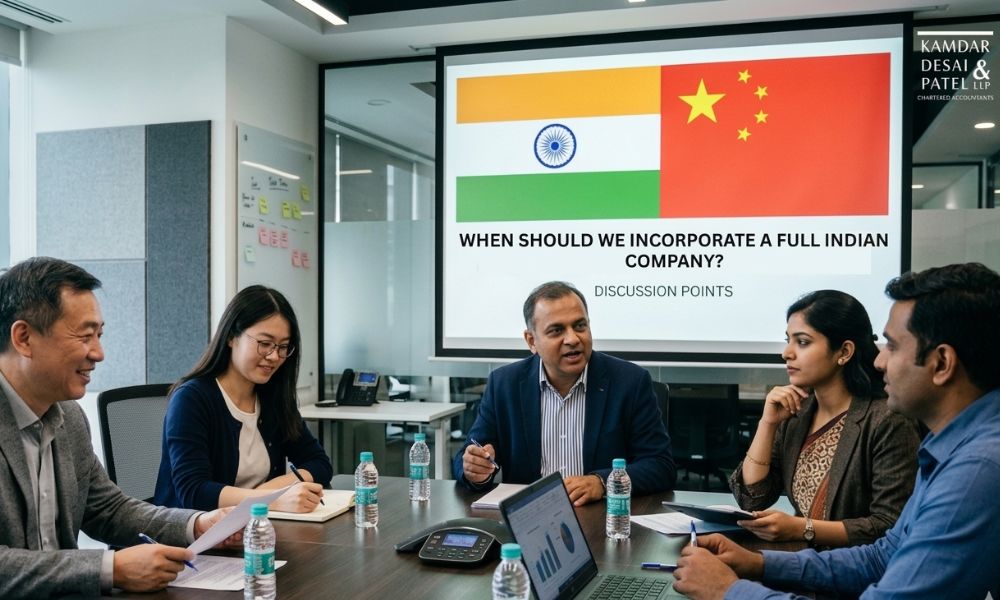
If your objective is to hire a large local team, sign domestic contracts, raise local invoices, and build a long-term operation, incorporating a company under the Indian Companies Act is the standard approach.
Wholly Owned Subsidiary (WOS):
This is for founders who want to have full control over their business and are dedicated to the Indian market. You still own all of your equity and have the power to make decisions, but you have to get FDI approvals on your own.
Joint Venture (JV):
This works best when you need to get into a market quickly, do business locally, and get help with regulations. If the equity split and control mechanisms are set up to follow FDI rules, a strong Indian partner can help deal with local problems.
Taxes and Repatriation:
An Indian company pays a standard corporate tax rate. When you want to repatriate profits out of India, you declare dividends. These are subject to withholding taxes, and the process requires standard board approvals and tax filings.
What if we only want to test the market?
You can open a Liaison Office if you don't want to commit to a full business.
A Liaison Office acts strictly as a communication channel. You can use it to understand local market demand, promote your parent company, and build relationships. However, you cannot sell, invoice, or earn any revenue in India. All expenses must be funded by your parent company abroad. The Reserve Bank of India (RBI) generally grants this setup for a validity period of three years.
Can we provide services or support without a full company?
Yes, through a Branch Office.
This structure is practical for service-led or support extensions of your parent company. A Branch Office is permitted to export and import goods, provide IT services, offer consultancy, or act as a buying and selling agent. It is strictly prohibited from retail trading or direct manufacturing.
Taxes and Repatriation: In India, a branch office is taxed like a foreign company, which means it pays a higher corporate tax rate than a local subsidiary. But sending those profits back to your headquarters is usually easier because there are no taxes on dividends.
Is there a structure for executing a single contract?
If you have already secured a specific contract from an Indian company (such as an infrastructure or IT project), you can open a Project Office.
This allows you to set up operations solely to deliver that exact project. Once the contract is fulfilled, the office closes. It is a targeted approach that keeps your long-term compliance footprint small.
Are there hidden operational hurdles for these offices?
There is one specific restriction founders must plan for when considering a Branch or Project Office.
Chinese businesses need permission from the RBI before they can buy or rent property in India (usually for leases longer than five years). So, if we simplify the explanation, you might be able to get permission to open a Branch Office, but it might take longer to get permission to rent office space for your employees. Founders must factor these logistical constraints into their launch timelines or prioritize the use of temporary serviced offices until formal regulatory clearance is secured.
How do we choose the right setup?

Choosing your entry route comes down to matching your legal structure to your business goals:
- To explore the market without revenue: Liaison Office
- To execute a single, defined B2B contract: Project Office
- To provide specific services or support to the parent: Branch Office
- To control your operations and scale independently: Wholly Owned Subsidiary
- To scale quickly leveraging a local partner: Joint Venture
The Final Word:
Entering India as a business with Chinese stakeholders requires exact planning. Choosing the wrong structure without analyzing how your specific ownership chain, veto rights, and sector will be viewed by regulators leads to stalled operations and frozen capital.
If your ownership analysis is complex, it is necessary to map out the structure with an expert before initiating any filings.
Need clarity on your India setup route? Message the KDP team on WhatsApp for a direct assessment of your ownership structure and timelines before committing to an entry strategy.
(1).png)
Sanjeev Kamdar
Author
Sanjeev Kamdar is a Senior Partner at Kamdar Desai & Patel LLP, a firm with over 70 years of professional legacy. With more than 35 years of experience, he specializes in advising international corporates and NRIs on Indian regulatory, tax, and foreign exchange laws.
Having gained early exposure to global financial practices in London, he has played a key role in shaping the firm’s focus on cross-border advisory services since 1991. His approach is practical and solution-driven, helping clients navigate complex regulations and achieve seamless business operations in India.