


HR Policy Localisation in India: A Guide for Foreign Companies
Why "Copy-Paste" Global HR Policies Don't Work in India
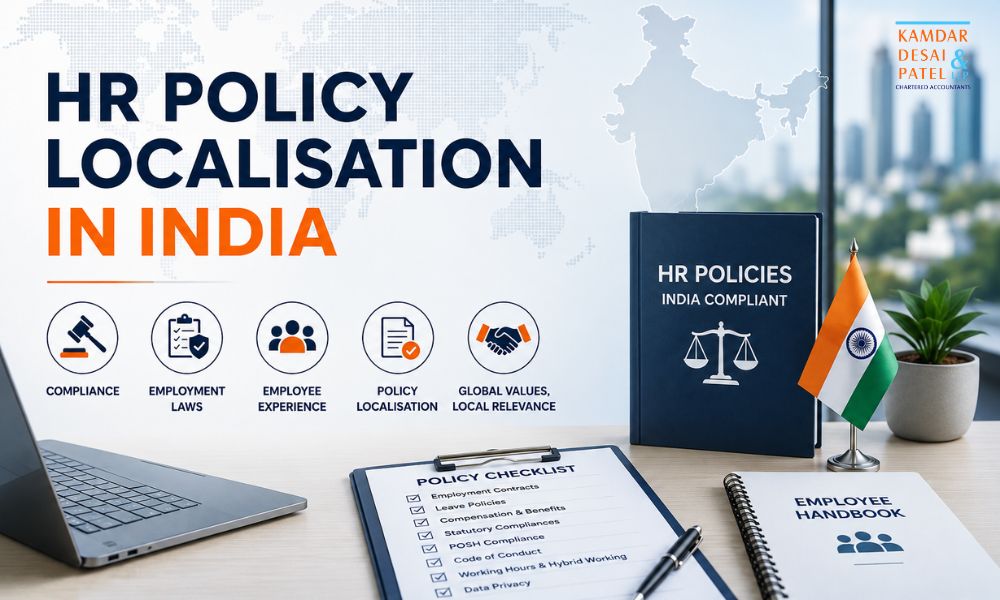
Expanding into India is an exciting milestone for any multinational organisation. HR policy localisation is one of the most critical steps for foreign companies to ensure compliance with Indian employment laws and build a strong workforce.
You've incorporated your legal entity. Tax registrations are in place. Business plans are ready. Hiring has begun.
Then comes an important question that often catches organisations by surprise:
Can we simply roll out our global HR policies in India?
Not quite. One of the most overlooked aspects of entering the Indian market is HR policy localisation or what many HR professionals refer to as "Indianising" global HR policies.
It's much more than replacing a few legal references or changing holiday dates. Done well, HR localisation helps organisations remain true to their global culture while ensuring their people practices comply with Indian laws and reflect local workplace realities.
Getting it right from the beginning creates a solid foundation for compliance, employee trust and sustainable business growth.
Why HR Policies Localisation in India Matters for Foreign Companies
India has one of the world's most complex employment law frameworks.
Unlike many countries, employment legislation isn't governed by a single national law. Organisations must navigate a combination of:
- Central labour legislation
- State-specific employment laws
- Industry-specific regulations
- Different requirements depending on the type of establishment and employee category
This means a policy that works perfectly in Europe, North America or Australia may not be legally compliant or even practical when implemented in India.
The goal isn't to replace your global HR philosophy. It's to make sure it works effectively in the Indian context.
HR policy localisation in India helps organisations:
- Stay compliant with Indian employment laws
- Reduce legal, financial and operational risk
- Maintain consistency with global HR principles
- Deliver a seamless employee experience across geographics
- Build confidence with employees, leaders and regulators
Where Do Global HR Policies Usually Need Localisation
While every organisation is different, these are the areas that most commonly require adaptation.
Employment Contracts
Employment contracts often need significant changes to reflect Indian legal requirements around probation, Indian labour laws, notice periods, confidentiality, intellectual property, restrictive covenants, retirement age, statutory benefits and termination provisions.
A contract that's standard in another country may leave important gaps under Indian employment law.
Leave Policies
This is one area where organisations are frequently surprised.
Leave isn't governed by one national standard. Entitlements vary across states and legislation.
Your policy should clearly address:
- Earned or privilege leave
- Casual leave
- Sick leave
- National and state-specific holidays
- Leave accural
- Carry forward rules
- Leave encashment
- Other statutory leave requirements
And, mandatory public holidays such as Republic Day (26 January), Independence Day (15 August) and Gandhi Jayanti (2 October) also need to be factored in.
Compensation Structure
This is perhaps the biggest adjustment for many multinational organisations. Globally, compensation may simply consist of:
- Base salary
- Bonus
- Benefits
In India, salary structures typically include several statutory components, such as:
- Basic salary
- House Rent Allowance (HRA)
- Provident Fund (PF)
- Professional Tax
- Other statutory deductions and allowances
Designing compensation correctly from the outset helps avoid payroll complications and compliance issues later.
Statutory Benefits
Indian employment law requires organisations to provide several statutory benefits, depending on eligibility.
These may include:
- Employee's Provident Fund (EPF)
- Gratuity
- Employee State Insurance (ESI)
- Payment of bonus
- Employee Compensation
These aren't optional benefits, they're legal obligations.
Maternity & Family-Friendly Policies
Many global organisations already offer generous parental benefits. However, these should also be aligned with the Maternity Benefit Act, including requirements around:
- Maternity leave
- Nursing breaks
- Creche facilities (where applicable)
Prevention of Sexual Harassment (POSH)
India has a dedicated law governing workplace sexual harassment. Localisation goes beyond updating the policy, it also requires organisations to:
- Constitute an Internal Committee (IC)
- Establish complaint and investigation procedures
- Conduct employee awareness programmes
- Meet statutory reporting requirements
Code of Conduct, Gifts & Hospitality
Your global Code of Conduct doesn't need replacing. It does, however, need local context.
Policies should reflect Indian regulatory expectations around:
- Gifts and hospitality
- Anti-bribery
- Conflicts of Interest
- Dealings with government officials
Whistleblower & Ethics Framework
Employees should clearly understand:
- How to report concerns
- Investigation processes
- Confidentiality protections
- Their rights under the Indian legal framework
A global whistleblower policy often benefits from country-specific guidance.
Working Hours, Attendance & Hybrid Working
Flexible work is becoming the norm, but labour law requirements still apply.
Policies should address:
- Working hours
- Weekly holidays
- Attendance
- Overtime
- Hybrid and remote working arrangements
while remaining compliant with applicable legislation.
Data Privacy & Information Security
With India's evolving data protection framework, organisations should review:
- Employee privacy notices
- Monitoring practices
- Confidentiality obligations
- Information security requirements
to ensure they align with both Indian regulations and global standards.
Performance Management, Separation & Full & Final Settlement
Employee exits often carry the greatest legal risk.
Policies should clearly define:
- Performance management processes
- Disciplinary procedures
- Notice periods
- Resignation processes
- Termination procedures
- Exit documentation
- Full & Final Settlement timelines
HR Localisation Isn't Just About Compliance
Here's where many organisations get it wrong. They assume localisation means rewriting every policy from scratch.They assume localisation means rewriting every policy from scratch.
It doesn't, the objective is to preserve your organisation's global philosophy while adapting how those principles are implemented in India.
For example,
- Your global rewards philosophy can remain exactly the same even though salary structures are redesigned for Indian payroll requirements.
- Your global Code of Conduct can continue to uphold the same ethical standards while incorporating India's statutory requirements around POSH, anti-corruption and whistleblowing.
That's what effective localisation looks like: global consistency with local relevance.
Why HR and Legal Teams Need to Work Together
Successful localisation sits at the intersection of employment law and people practices.
Legal experts identify statutory obligations and regulatory risks.
HR professionals ensure policies are practical, culturally relevant and aligned with the organisation's employee experience and business objectives.
The strongest localisation projects combine both perspectives to create policies that are legally compliant, operationally effective and globally consistent.
A Quick HR Localisation Health Check
Before implementing your global HR policies in India, ask yourself:
- Are our employment contracts compliant with Indian employment laws?
- Does our leave policy reflect state-specific statutory requirements?
- Is our compensation structure aligned with Provident Fund, gratuity and Indian payroll practices?
- Have we addressed statutory requirements relating to bonus, maternity benefits and crèche facilities?
- Is our POSH framework fully compliant, including the constitution of an Internal Committee?
- Do our Code of Conduct, Gifts & Hospitality and Conflict of Interest policies reflect Indian legal expectations?
- Are our working hours, attendance and hybrid working policies compliant with local labour laws?
- Are our employee privacy and data protection policies aligned with India's evolving legal framework?
- Have we reviewed our disciplinary, resignation, termination and Full & Final Settlement processes?
Conclusion
HR localisation shouldn't be treated as an administrative exercise completed after incorporation. It's a strategic investment.
Well-localised HR policies for foreign companies in India help organisations minimise risk, strengthen governance and deliver a consistent employee experience from day one. Most importantly, they allow organisations to stay true to their global values while operating confidently within India's unique legal and regulatory landscape.
As more businesses expand into India, the organisations that succeed won't necessarily be those with the best global policies. They'll be the ones that know how to adapt them thoughtfully balancing global consistency with local relevance.
At KDP Accountants, we understand every foreign business entering India faces unique HR compliance policies and challenges. Our team of professionals works closely and ensure all multinational companies and foreign businesses to help localise HR policies with Indian employment laws and regulatory requirements. Connect with us at enquire@kdpaccountants.com to know more about HR Advisory and compliance services.

Nisha DasGupta
Author
Nisha DasGupta is a Global HR Leader, Independent HR Consultant and ICF-certified Executive Coach with over two decades of experience supporting multinational organisations through business growth, transformation and global expansion. Drawing on extensive experience in HR leadership and policy implementation, she helps organisations entering India adapt global people practices to local legal, cultural and operational requirements. Her work focuses on creating practical, compliant HR solutions that enable organisations to build high performing workplaces while staying true to their global values.