


AOC-4 and MGT-7 Filing: The Two ROC Filings Every Company Owes After Its AGM
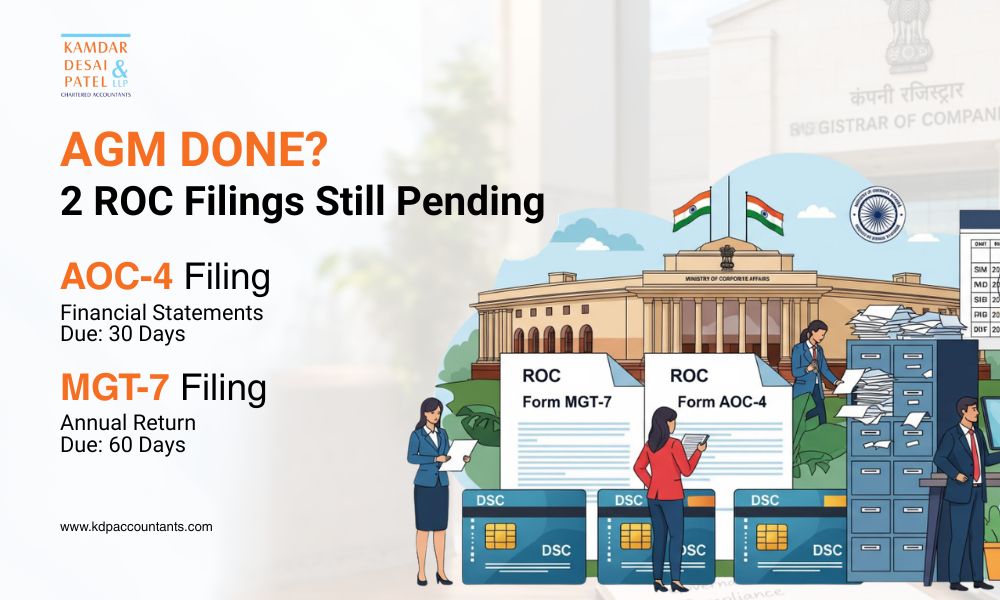
The AGM wraps up, the resolutions are signed, and for most finance teams that feels like the finish line for the year. It isn't. Two more filings fall due at the Registrar of Companies within weeks of that meeting, Form AOC-4, which reports your financial statements, and Form MGT-7, your annual return. Between them, these two forms tell the regulator, and eventually any lender or investor who looks, almost everything about how the company was run that year. Miss either one, and the daily penalty is the smaller problem. The bigger one shows up months later, in a due diligence data room or a loan renewal, when “filing pending” is the answer nobody wants to give.
Form AOC-4 Filing: What the Year Actually Looked Like
Under Section 137 of the Companies Act, 2013, every company registered in India has to file its audited financial statements with the ROC, not as a formality, but as the primary public record of how the business performed. This is done through Form AOC-4, and it bundles together:
- The Balance Sheet
- Statement of Profit and Loss
- Cash Flow Statement, where applicable
- Notes to Accounts
- The Board’s Report
- The Auditor’s Report
- Any other document the Companies Act requires for that company
None of this should come as a surprise to anyone on the finance team, it’s the same set of statements the auditor has already signed off on, prepared in line with Schedule III and the applicable Accounting Standards, now formally handed to the regulator.
When the Filing Has to Be in XBRL
Some companies don’t file a plain AOC-4, they file AOC-4 XBRL, a structured, machine-readable version of the same statements. Think of it as the same financials, reformatted so a regulator’s system can read them without manual re-entry, rather than a different set of numbers.
The requirement applies once a company crosses certain thresholds:
- Listed companies, and their Indian subsidiaries
- Companies with paid-up share capital of ₹5 crore or more
- Companies with annual turnover of ₹100 crore or more
- Any other class the Ministry of Corporate Affairs notifies separately
Banking, insurance, and power companies, along with NBFCs filing under their own specified formats, sit outside this and follow separate rules. The number that trips people up most is turnover, not paid-up capital, a company can cross ₹100 crore in revenue well before it ever raises capital, and the XBRL obligation follows the number, not the funding stage.
Where There Are Subsidiaries: Consolidated Financial Statements
If the company has one or more subsidiaries or associate companies, the ROC doesn’t stop at the standalone numbers. Consolidated Financial Statements (CFS), prepared under the applicable Accounting Standards, must also be filed, as Form AOC-4 CFS, or the XBRL equivalent where that applies, along with the prescribed attachments.
Form MGT-7: The Annual Return
Where AOC-4 is about the money, MGT-7 is about the company itself. Filed under Section 92 of the Companies Act, 2013, it’s a snapshot of the company’s structure and governance as it stood at year-end, who owned what, who sat on the board, and what decisions were made. It covers:
- Registered office and principal business activities
- Holding, subsidiary, and associate companies
- Share capital, securities, and shareholding pattern
- Details of members, directors, and Key Managerial Personnel (KMP)
- Board, committee, and shareholder meetings held during the year
- Remuneration paid to directors and KMP
- Penalties, compounding of offences, and other statutory disclosures
Most companies file the full MGT-7. One Person Companies and Small Companies file the shorter Form MGT-7A instead, same purpose, lighter form.
One certification step catches people off guard: once paid-up share capital reaches ₹10 crore, or turnover reaches ₹50 crore, the annual return also needs to be certified by a Practising Company Secretary, in Form MGT-8. It’s worth checking this threshold every year rather than assuming last year’s answer still holds, a company can cross it without anyone noticing until the filing is due.
When Both Are Due
| Filing | Due within | If the AGM isn't held |
|---|---|---|
| Form AOC-4 / AOC-4 XBRL | 30 days from the AGM (180 days from financial year-end for an OPC) | 30 days from the last date the AGM should have been held, with a statement of reasons |
| Form MGT-7 / MGT-7A | 60 days from the AGM | 60 days from the last date the AGM should have been held, with a statement of reasons |
It’s easy to conflate the two deadlines because they run from the same date, but AOC-4 falls due a full month before MGT-7 does, and treating them as one task is usually how the second one gets missed.
What Missing the Deadline Actually Costs
Under Section 137, delayed filing carries an additional fee of ₹100 per day, with no cap on how long it can run, separate from any penalty the Act allows the Registrar to impose on the company and its officers for the non-compliance itself. That’s the formal cost. The informal one tends to matter more: a pending ROC filing is one of the first things that surfaces in a due diligence checklist, a bank’s compliance review, or an investor’s data room request, and it raises a question about the company’s discipline that has nothing to do with the number itself.
In Practice
At KDP Accountants, we’ve been filing annual returns and financial statements for clients for decades, and the pattern rarely changes. For professional assistance, connect with us at enquire@kdpaccountants.com, the companies that stay ahead of it don’t have fewer subsidiaries or simpler shareholding, they just treat the AGM as the start of a checklist, not the end of one. The rest is mostly about knowing which threshold applies to you this year, not which one applied last year.
FAQs
Can AOC-4 or MGT-7 be filed before the AGM?
No. Both forms report on what was approved at the AGM, so filing isn’t permitted until the meeting has actually been held.
What if the company didn’t hold an AGM this year?
The filing clock still runs: 30 days for AOC-4 and 60 days for MGT-7, counted from the date the AGM should have been held, along with a statement explaining why it wasn’t.
Does a private company need MGT-8?
Yes, if it crosses either the paid-up capital or turnover threshold. The requirement doesn’t distinguish between public and private companies.
Are LLPs required to file in XBRL format?
No. The XBRL filing rules apply to companies under the Companies Act, 2013. LLPs file their annual accounts separately, under the LLP Act.
Is there a limit to how high the late filing fee can go?
No, the additional fee under Section 137 accrues per day of delay with no upper ceiling, which is exactly why it’s worth catching early rather than letting it run.
.png)
Nidhi Mehta
Author
Nidhi Mehta is associated with the profession of Company Secretaries and is engaged in advising businesses on corporate law, governance, and regulatory compliance. Her professional experience encompasses a wide range of secretarial matters, including Companies Act, 2013 compliances, corporate advisory, ROC filings, board and shareholder processes, share capital transactions, corporate restructuring, Dematerialisation of shares and all other ongoing compliance management. With a practical and solution-oriented approach, she strives to present complex concepts in a clear and accessible manner, helping businesses and professionals stay informed, compliant, and aligned with evolving corporate laws.