


How to Incorporate a Company in India in 2026: Complete Guide for Founders, NRIs, and Foreign Companies

For founders, NRIs, and overseas companies looking to incorporate a company in India, 2026 offers a faster and more digital setup environment. India continues to attract serious business interest because it combines market opportunity, skilled talent, and long-term growth potential.
But incorporation is not just about filing a form on the MCA portal. The bigger challenge is choosing the right entity, preparing foreign documents correctly, meeting the resident director requirement, and planning for FEMA, RBI, tax, and post-incorporation compliance from the start.
What should founders know before they incorporate a company in India in 2026?
India remains a strong entry market because MCA SPICe+ now combines name reservation, incorporation, DIN, PAN, TAN, and linked registrations in one workflow. In 2026, the real complexity is usually not filing. It is choosing the correct structure, meeting the resident director rule, authenticating foreign documents, and planning FEMA/RBI compliance.
If you are planning an India entry, treat incorporation as a legal and compliance project, not just a filing task. The form is only one part of the setup. The structure, foreign-investment position, documentation quality, and post-incorporation readiness will shape how smoothly the business operates after registration.
Can foreigners, NRIs, and overseas companies incorporate a company in India?
Yes. Foreign nationals, NRIs, and overseas companies can incorporate in India, and many sectors allow up to 100% FDI under the automatic route. But this is not universal. Sectoral caps, entry-route conditions, beneficial ownership checks, and land-border country restrictions can still move an investment to the Government route.
The legal position is broad, but the practical answer always depends on the sector, investor profile, and ownership chain. Founders should not assume that "100% FDI allowed" automatically means no approvals, no scrutiny, or no special conditions in their case.
What resident director rule must the company meet?
Indian company law requires at least one resident director, not necessarily an Indian citizen. Under Section 149, the resident director must satisfy the 182-day stay requirement in India during the financial year. For a Private Limited Company, the law also generally requires two directors and two members at incorporation.
This is one of the most misunderstood rules for foreign founders. NRIs and foreign nationals can be directors, but the company must still satisfy the resident-director requirement. That means the appointment should be planned carefully from both a legal and governance perspective.
How is an Indian company different from a branch office or liaison office?
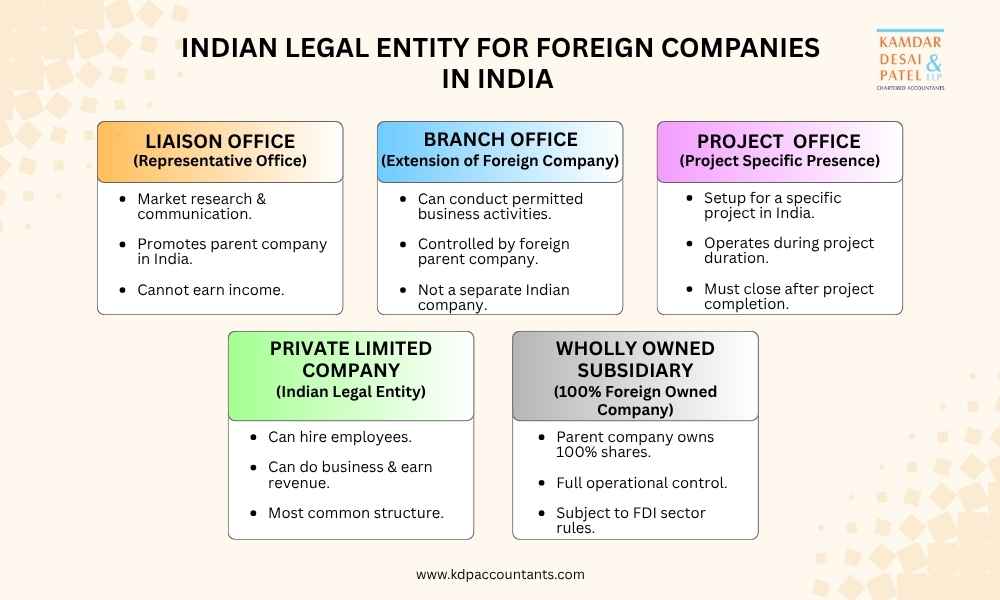
A Private Limited Company or Wholly Owned Subsidiary creates an Indian legal entity that can contract, hire, invoice, and scale locally. A Branch Office or Liaison Office is different. These operate under RBI/FEMA rules, and a Liaison Office cannot undertake business activity or earn income in India.
| Entity Type | Foreign Ownership Allowed | Practical Use | Key Limitation |
|---|---|---|---|
| Private Limited Company | Yes, subject to sectoral rules | Most common operating vehicle for foreign founders | Must meet Companies Act and compliance requirements |
| Wholly Owned Subsidiary | Yes, where 100% FDI is permitted | Best fit for overseas parent companies wanting full control | Depends on sectoral FDI position |
| LLP | More limited | Works in selected cases | Allowed only in sectors with 100% automatic-route FDI and no conditions |
| Branch Office | Yes, under RBI/FEMA framework | Extension of foreign company for permitted activities | Not an incorporated Indian company |
| Liaison Office | Yes, under RBI/FEMA framework | Representative presence only | Cannot carry on business or earn income in India |
| Project Office | Yes, under FEMA framework | Permitted to carry on activities relating to a specific project | Must be wound up once the project is complete |
Many articles blur these options together, but they are not interchangeable. A foreign company that needs a real India operating vehicle usually needs an incorporated Indian entity, not a representative office. A Liaison Office is especially limited because it cannot undertake business activity in India.
Which business structure is usually best for foreign founders?
For most international operating businesses, a Private Limited Company is the standard choice because it supports limited liability, equity ownership, hiring, local invoicing, fundraising, and ESOPs. A Wholly Owned Subsidiary usually works best for foreign parents needing full control, while an LLP fits narrower cases with 100% automatic-route FDI and no performance conditions.
The right structure depends on what the India entity needs to do in practice. If the goal is hiring, selling, contracting, invoicing, and scaling locally, the answer is usually different from a case where the parent only needs a narrow advisory or representative presence.
When is a Private Limited Company the right fit?
A Private Limited Company is usually the best fit for foreign founders who want an Indian operating entity with limited liability, clear shareholding, local contracting ability, employee hiring, ESOP flexibility, and future fundraising capacity. It is the standard structure for most scalable businesses and for many foreign-owned Indian subsidiaries.
A good example is a foreign SaaS company that wants to hire a local team, contract with Indian clients, and build long-term operations. In that case, a Private Limited Company is usually more practical than a branch or liaison structure.
When is a Wholly Owned Subsidiary the right fit?
A Wholly Owned Subsidiary is generally appropriate when an overseas parent wants 100% ownership, operational control, ring-fenced India risk, and an entity that Indian banks, customers, vendors, and employees recognise easily. It is usually cleaner than a representative office when the parent needs a full Indian operating company.
In practice, this is often the preferred format for overseas companies expanding into India. It creates a clear governance structure while keeping Indian operations within a familiar local legal framework.
When can an LLP work for foreign founders?
An LLP can suit smaller advisory, consulting, or professional-services models, but it is not a universal foreign-entry vehicle. Foreign investment is allowed only where the sector permits 100% FDI under the automatic route and has no FDI-linked performance conditions, which limits flexibility for many international founders.
That makes an LLP useful in some cases, but it is often less flexible than a Private Limited Company for foreign founders who want a broader operating business or more future-ready corporate structure.
What are the main legal requirements to incorporate a company in India?

To incorporate a standard Private Limited Company, you generally need two directors, two shareholders or members, one resident director, a registered office, DSCs for signatories, and DINs for directors. There is no general minimum paid-up capital requirement, but sector-specific capital, licensing, or regulatory conditions can still apply.
| Requirement | Standard Rule for a Private Limited Company | Why It Matters |
|---|---|---|
| Directors | Minimum 2 | Needed to form and manage the company |
| Resident Director | At least 1 | Required under Section 149 |
| Shareholders / Members | Minimum 2 | Required under the Companies Act |
| Registered Address | Mandatory | Needed for MCA records and official notices |
| Digital Signature (DSC) | Required for signatories | Needed to sign electronic filings |
| Director Identification Number (DIN) | Required for directors | Usually applied for during the incorporation process |
Two points create the most real-world friction for foreign founders: the resident director and the registered office. These are not box-ticking items. They affect governance, notices, control, and operational readiness, so they should be planned properly before filing starts.
What documents are required for company incorporation in India?
The document set will depend on whether the subscriber or director is an Indian resident, NRI, foreign national, or foreign body corporate. Foreign cases commonly require passport and overseas address proof, notarisation, apostille, and corporate authority documents such as a certificate of incorporation, charter documents, and a board resolution authorising the signatory.
| Applicant Type | Common Documents Required |
|---|---|
| Indian Director / Shareholder | PAN, Aadhaar or other ID, address proof, passport-size photo |
| Foreign Director / Shareholder | Passport, overseas address proof, passport-size photo, notarised and apostilled documents where applicable |
| Foreign Company Subscriber | Certificate of incorporation, charter documents, board resolution authorising signatory, authorised signatory documents |
Foreign founders usually face delays because the paperwork must line up across jurisdictions. Name spelling, signatory authority, address proof, board approval language, and authentication format all need to match cleanly across the incorporation package.
Why do apostille and foreign document rules matter so much?
Foreign incorporation delays usually happen at the authentication stage, not the MCA filing stage. Where a subscriber signs outside India, documents must be legalised as prescribed under Rule 13. If the country is in the Hague Apostille Convention, notarised and apostilled documents are generally accepted for use in India.
This is why foreign cases often move slower than domestic incorporations. The filing may be online, but the preparation work is still cross-border, document-heavy, and highly sensitive to inconsistencies.
How do you incorporate a company in India step by step?
The incorporation process is largely digital in 2026, but the order still matters. Founders must arrange DSC, secure the right company name, file SPICe+ Part A and Part B, submit MoA, AoA, declarations, and foreign authentication papers, receive the Certificate of Incorporation, and then complete FEMA/RBI reporting after investment.
- Obtain Digital Signature Certificate (DSC): Proposed signatories need a DSC to sign and file incorporation documents electronically. This applies to foreign nationals as well.
- Apply for Director Identification Number (DIN): Directors need a DIN. In many cases, DIN allotment is integrated into the SPICe+ incorporation workflow.
- Reserve the company name through SPICe+ Part A: The name should be distinctive, compliant, and aligned with the proposed business activity. Generic or conflicting names are often rejected.
- File SPICe+ Part B: This is the main incorporation filing. It captures capital structure, registered office, directors, subscribers, and core company details.
- Submit MoA, AoA, declarations, and foreign papers: Founders must file the Memorandum of Association (MoA), Articles of Association (AoA), declarations, and all required foreign authentication documents.
- Receive the Certificate of Incorporation: Once approved, MCA issues the Certificate of Incorporation, and the company receives its CIN, PAN, and TAN through the integrated process.
- Complete capital infusion and FEMA/RBI reporting: If the company receives non-resident investment, the post-allotment compliance calendar must already be mapped. This is where many founders make avoidable mistakes.
Although the process is digital, foreign-owned incorporations still need careful sequencing. Delays or rejections often happen when the company name, subscriber details, foreign document authentication, or parent-entity records are not prepared and filed in the correct order.
How long does company incorporation usually take in India?
A clean domestic case may finish in 7 to 15 working days, but foreign-owned, NRI-led, or subsidiary setups often take 15 to 25 working days or longer. The main variables are name approval, document readiness, apostille timelines, sector checks, overseas corporate papers, and MCA processing.
A fast incorporation is possible only when the structure is simple and the documents are unusually clean. Foreign-led cases should plan for a longer runway because the timeline is often driven more by document preparation and cross-border coordination than by MCA filing speed.
How much does it cost to incorporate a company in India?
Founders should budget in four buckets: government fees and stamp duty, DSC costs, foreign-document authentication and courier costs, and professional fees. Standard Indian incorporations often fall around ₹25,000 to ₹35,000, while foreign subsidiaries or complex cross-border structures may range from ₹60,000 to ₹2,50,000+, excluding ongoing compliance.
| Cost Bucket | What It Usually Includes |
|---|---|
| Government fees and stamp duty | MCA filing charges, state-based stamp duty |
| DSC costs | Digital signature setup for signatories |
| Foreign-document costs | Notarisation, apostille, courier, certified copies |
| Professional fees | Structuring, drafting, filing, foreign-investment guidance, compliance setup |
The bigger budget mistake is focusing only on formation cost. Foreign-owned companies should also plan for accounting, annual filings, tax support, GST support if applicable, FEMA/RBI reporting, payroll, and transaction-based advisory such as transfer pricing or ECB review where relevant.
What compliance requirements apply after incorporation?
After incorporation, the real work begins. Most companies need bookkeeping, statutory records, ROC filings, income-tax compliance, and board housekeeping. If the company has foreign investment, additional layers may include FEMA/RBI reporting, FLA return obligations, transfer pricing documentation, GST registration where applicable, and ECB review before foreign borrowing.
Core post-incorporation compliance
- Bookkeeping and statutory accounting records
- ROC filings
- Income-tax compliance
- Board and corporate housekeeping
- GST registration, if threshold or compulsory registration rules apply
- Payroll and employment compliance, where relevant
Foreign-investment compliance
- FEMA/RBI reporting
- FC-GPR tracking after allotment
- FLA return obligations
- Transfer pricing documentation for international transactions
- ECB review before overseas borrowing
This is why incorporation should never be treated as the finish line. For foreign-owned companies, the real compliance burden often starts after the entity is formed and capital begins to move.
Why do foreign companies continue to choose India?
Foreign companies choose India because it offers market demand, skilled talent, and an investment regime where most sectors are open to 100% FDI under the automatic route. For many founders, India functions at once as a revenue market, hiring market, and operating base, which strengthens long-term expansion logic.
That combination matters. India is not only a place to sell. For many businesses, it is also a place to hire, build teams, create delivery capacity, and establish a long-term operating footprint.
What common mistakes do foreign founders make?
The biggest errors are choosing the wrong structure, appointing a resident director casually, underestimating apostille and foreign authority paperwork, and treating incorporation as the finish line. Foreign-owned companies often need structured support for FEMA/RBI reporting, transfer pricing, annual compliance, and sometimes ECB-related issues immediately after incorporation.
- Choosing the entity structure by habit instead of function
- Treating the resident director appointment casually
- Underestimating notarisation, apostille, and board approval requirements
- Assuming incorporation ends the legal process
- Ignoring FEMA/RBI and post-investment reporting needs
- Failing to budget for annual and tax compliance
The most expensive India-entry mistake is often not a rejected filing. It is setting up the right-looking company on paper but the wrong practical structure for the actual business model.
How can KDP help foreign founders incorporate in India?
KDP is best suited for founders who need more than basic form filing. The value lies in structure selection, resident-director planning, registered-office readiness, apostille coordination, FEMA/RBI reporting, annual compliance, transfer pricing, and ECB-linked support. This is especially relevant for foreign companies, NRIs, and serious India-entry projects.
KDP's strength is not low-cost filing. It is helping founders make the right decisions — choosing the appropriate entity and maximising tax benefits — before money is spent and before mistakes become expensive. That matters more in cross-border cases where the legal structure and compliance pathway need to be right from the start.
What should your India incorporation checklist include?
If you are preparing to incorporate a company in India, your checklist should cover structure selection, director and shareholder documents, resident-director planning, registered-office readiness, SPICe+ steps, post-incorporation calendars, and FEMA/RBI reminders.
- Structure selection questions
- Director and shareholder document list
- Resident-director planning points
- Registered-office readiness items
- SPICe+ filing steps
- Post-incorporation compliance calendar
- FEMA/RBI reporting reminders for foreign investment
A checklist works well as a lead magnet because it helps serious founders move from research to execution. It also filters for visitors who are actively planning incorporation, not just casually reading.
What is the safest way to start a company in India in 2026?
The safest approach is to choose the structure first, validate FDI eligibility, prepare foreign documents correctly, and map post-incorporation compliance before filing. That prevents the most expensive mistake: creating a company that is legally formed but operationally misaligned.
The strongest India-entry strategy is simple. Do the structuring early, get the documents right before filing, and treat compliance planning as part of incorporation itself. That is what prevents delays, avoids future corrections, and creates a workable operating setup.
Frequently Asked Questions
Can foreigners own 100% of a company in India?
Often yes. 100% foreign ownership is possible where the relevant sector permits 100% FDI, the entry route is automatic or required approvals are obtained, and no special restriction applies. It is not a universal rule because sectoral caps, Government-route sectors, and land-border restrictions can still limit or delay investment.
Can NRIs be directors of an Indian company?
Yes. NRIs and foreign nationals can serve as directors of an Indian company, but the company must still appoint at least one resident director who satisfies the 182-day stay test under Section 149. A private company also generally needs two directors and two members to incorporate.
Do foreign companies need a resident director in India?
If a foreign company incorporates an Indian entity, that Indian company must have at least one resident director under Companies Act, 2013 rules. But if the foreign company opens a Branch Office or Liaison Office instead, the framework is different because those establishments are governed primarily by RBI/FEMA.
How long does company incorporation take in India?
Straightforward domestic incorporations commonly take about 7 to 15 working days. Cases involving foreign shareholders, apostille, overseas company subscribers, sector checks, or Government-route questions often take 15 to 25 working days or more. The actual timeline depends less on the form and more on document readiness and cross-border coordination.
What is the minimum capital required?
There is no general statutory minimum paid-up capital for a Private Limited Company in India. Founders can usually incorporate with a practical capital structure that suits operations. However, this does not remove sector-specific capital thresholds, licensing rules, or regulatory conditions, which may still apply to certain business models.
Is LLP a good structure for foreign founders?
Sometimes. An LLP can work for leaner advisory or professional-services setups, but foreign investment is permitted only where the sector allows 100% FDI under the automatic route and there are no FDI-linked performance conditions. That makes LLPs less flexible than a Private Limited Company for many foreign founders.