


What SEBI's New GARUDA Mechanism for AIFs Means for Your Next Fund Launch
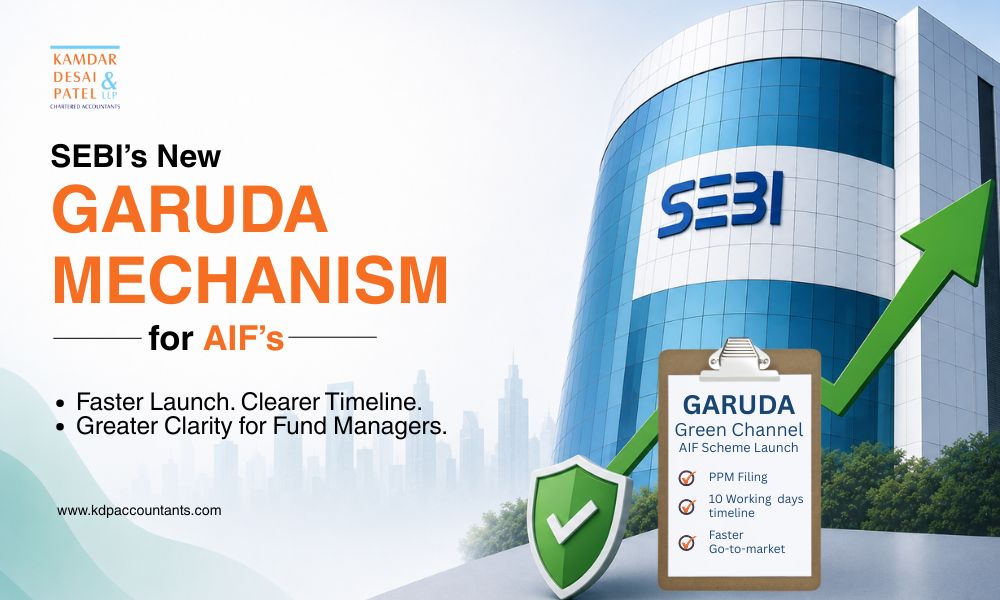
Fund managers know the gap between “keen to raise” and “ AIF scheme cleared to raise.” Our usual experience is a wait of 90 to 120 days for the fund to be cleared for a fundraise by SEBI.
The fund is structured, investors are committed, and the launch still waits on a calendar it doesn't control. SEBI's new GARUDA mechanism circular, “Green-Channel: AIF Rollout Upon Document Acknowledgement,” effective July 30, 2026, is proposed to be a direct response to that gap.
Well... with one caveat
“Automatic route” is the phrase circulating in the talks, and it's close, but not quite right for every fund. GARUDA creates two speeds. If your fund raises exclusively from Accredited Investors (AI-only fund) or writes cheques of INR 25 crore-plus (LVF), or if you run an Angel Fund (Cat-I AIF), launch is now genuinely fast: file the PPM, launch immediately. Everyone else, what the SEBI GARUDA circular now formally calls a “Regular scheme,” gets a firmer, shorter timeline, but the process itself is largely unchanged.
If you run an AI-only Fund, LVF, or Angel Fund
In our opinion, this is the group GARUDA was built for. You no longer need a Merchant Banker to file your PPM, and you no longer suffer the SEBI comment period. A new scheme can launch the moment its PPM is filed; your very first scheme can launch from the date of registration. The same applies to any changes you later make to the PPM, no Merchant Banker Certificate shall be required.
The trade-off: the Merchant Banker's independent due-diligence certificate is replaced by an undertaking signed by your CEO and your Compliance Officer. Responsibility for the accuracy of the PPM now sits with your leadership team, not an external gatekeeper. One naming detail to build into your documentation now: new AI (accredited investor Only) Fund schemes must carry “AI only fund” or “AIOF” in the name; new LVFs must carry “LVF.” This clearly raises responsibility on the compliance officer and internal process will result in a stretched preparation phase.
If you run a Regular scheme
The process remains more or less unchanged, PPM filed through a SEBI-registered Merchant Banker, with due diligence certification, Fit and Proper declarations, and PAN documentation, but the here is good news - waiting period is now defined: just 10 working days from filing, unless SEBI says otherwise. This clearly raises responsibility on the compliance officer and internal process will result in a stretched preparation phase. However, A first scheme can launch on registration or after the 10-day window, whichever is later. That's a real planning gain even without the exemption: you can now build a launch date into investor communications with confidence. This puts fund house in control of the process.
What this means for your next raise
Fund category now decides your launch runway, so get that classification right before the PPM is drafted, not after. If you're structuring a new scheme and it plausibly fits the AI Only or LVF bracket, it's worth asking whether it should; the speed difference is significant, and it flows directly into how quickly capital can start working.
For CEOs and Compliance Officers of exempt-category funds, the undertaking you're now signing carries the weight the Merchant Banker's certificate used to. Treat the review behind it with equivalent rigour; SEBI has removed a step, not a standard. This means there is no escaping the responsibility. Instead of a merchant banker, this now moves to your CEO and compliance officers.
A final thought
Regulatory speed usually comes with a catch, so a little scepticism is appreciated. But GARUDA reads as SEBI matching process to risk: sophisticated, well-capitalised investors get a faster path; everyone else keeps the same process with more defined response time and ability to predict launch and take investor commitment. For a fund manager, this is a great one!
Planning your next AIF launch?
KDP Accountants supports fund managers with AIF structuring, compliance, and regulatory requirements. For professional assistance with your next fund launch, connect with us at enquire@kdpaccountants.com.
FAQs
Does the SEBI GARUDA mechanism apply for AIF’s first scheme and subsequent schemes?
The fast-track registration under GARUDA applies to both a fund's first scheme and its subsequent schemes, but the two work slightly differently, and the practical benefit is larger for subsequent schemes.
Does GARUDA apply to funds already registered and operating?
Yes. It applies to “AIF Schemes” and any PPM filed from the date the SEBI (AIF) (Second Amendment) Regulations, 2026 were notified, regardless of when the fund itself was registered.
Can a Regular scheme opt out of the Merchant Banker requirement?
No. Only AI Only Funds, LVFs, and Angel Funds are exempt. Regular schemes continue to file through a SEBI-registered Merchant Banker.
Who signs the undertaking for an exempt-category fund?
The CEO of the Manager (or equivalent senior role) and the Compliance Officer of the Manager, in the format SEBI has prescribed.
What happens if disclosures in that undertaking are later found inaccurate?
The Manager is directly liable for the accuracy and completeness of the PPM, there is no external party to share that responsibility with.
Does the AIOF/LVF naming rule apply to schemes already in the market?
The circular applies it to new schemes being launched. Worth confirming treatment for anything currently mid-process.

Bhakti Dhiman
Author
Over 10 years of experience in the financial services industry, with strong expertise in Alternative Investment Funds (AIFs), Portfolio Management Services (PMS), SEBI regulations, and regulatory compliance. Experienced in interpreting and implementing SEBI regulations, circulars, amendments, and evolving regulatory guidelines. Manage and oversee periodic regulatory filings, ensuring accuracy, timeliness, and compliance with applicable requirements. Regularly analyse new SEBI circulars and amendments, evaluate their impact on AIF and PMS operations, and translate regulatory requirements into practical business processes. Actively collaborate and brainstorm with clients and internal stakeholders to interpret complex regulatory matters, address compliance challenges, identify potential risks, and develop practical, commercially viable solutions. Provide regulatory and compliance advisory support while ensuring processes remain aligned with the latest SEBI framework and industry practices.