


Investing in an Overseas Entity – Individual vs Indian Company
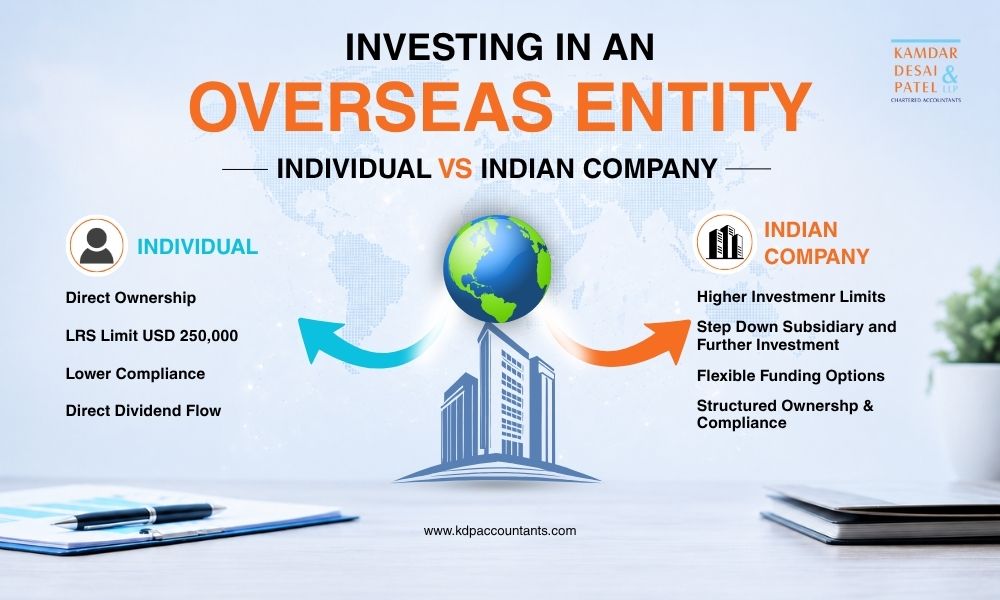
Indian entrepreneurs are increasingly considering overseas Investment from India, including families and businesses looking to expand internationally or participate in foreign businesses. However, before making an overseas investment, one important question is how the investment should be structured, directly by a resident individual or through an Indian company.
There is no one-size-fits-all answer. The appropriate structure depends on the size and purpose of the investment, future funding requirements, plans for overseas expansion, compliance obligations, tax impact and succession objectives.
In this article, we have explained the comparison of overseas investment by a resident individual vs an Indian company, covering key regulatory, financial, tax, and succession considerations to help you better understand which structure may be more appropriate for your objectives.
The following comparison highlights the key considerations:
| Particulars | Investment by Resident Individual | Investment through Indian Company |
|---|---|---|
| Who makes the investment? | The resident individual directly invests in the overseas entity and holds the shares personally. | The Indian company makes the investment in the overseas entity under the ODI framework. |
| Investment limit | Overseas investment is subject to the applicable LRS limit of USD 250,000 per financial year, along with the applicable Overseas Investment Rules and conditions. | The company's total financial commitment is subject to the applicable ODI framework, including the 400% of net worth limit, based on the latest audited balance sheet, subject to applicable conditions. |
| Ownership | Direct ownership by the individual provides flexibility in deciding personal or family ownership. | The overseas entity is owned by the Indian company, creating a corporate ownership structure. |
| Source of funds | Where multiple individuals invest, their respective contribution, ownership and movement of funds need to be separately documented. | Funding is centralised through the Indian company, making the flow of funds easier to track from an Indian corporate perspective. |
| TCS / Initial tax impact | Applicable TCS may arise on remittance under LRS. The TCS can generally be considered for adjustment against the individual's tax liability, subject to applicable tax provisions. | The comparison considered no withholding tax on remittance of share capital by the Indian company. |
| Step-down subsidiary / further investment | Where the foreign entity is controlled by a resident individual, restrictions apply on making further overseas investments or setting up a step-down subsidiary under the applicable framework. | A foreign entity wholly owned by an Indian entity can, subject to applicable conditions, establish a step-down subsidiary or make further overseas investments. |
| Future capital funding | Future contributions can be made by the individual(s), subject to their respective ownership arrangements and applicable FEMA requirements. Each additional contribution needs to be separately evaluated. | Future funding can generally be routed through the Indian company, subject to its financial commitment limits and applicable ODI requirements. |
| Funding by way of loan | A resident individual cannot make financial commitment by way of debt to the foreign entity under the ODI framework. | An Indian company may undertake debt/loan-related financial commitment, subject to applicable ODI conditions, limits and reporting requirements. |
| Dividend flow | Dividends from the overseas entity can be received directly by the individual shareholder, subject to applicable tax and regulatory requirements. | Dividends are first received by the Indian company. Any subsequent distribution to shareholders creates an additional distribution layer. |
| FEMA compliance burden | Relatively lower Indian-level compliance because only the resident individual's investment needs to be considered. | Relatively higher compliance because the investment is an Indian corporate ODI and subsequent transactions need to be monitored. |
| Annual compliance | The resident individual may have ongoing ODI reporting requirements, including APR where applicable. | The Indian company may have ODI compliances including APR, FLA return and other applicable reporting requirements. |
| Financial statement consolidation | Generally, direct investment by an individual does not by itself create a requirement to prepare consolidated financial statements. | The Indian company may need to consider consolidation of the overseas subsidiary's financial statements, subject to applicable accounting and Companies Act requirements. |
| Overseas registration / documentation | Relatively less corporate documentation may be required where the overseas entity has individual shareholders. | Additional corporate documents may be required because the overseas entity is wholly owned by an Indian company. |
| Succession planning | Succession can potentially be planned directly at the level of the overseas company's shares. | Succession can instead be considered at the Indian company shareholding level while the overseas entity remains wholly owned by the Indian company. |
| Administrative burden | Lower Indian corporate administrative burden, although individual FEMA compliance continues to apply. | Higher Indian corporate and FEMA compliance, but potentially a cleaner ownership structure for multiple overseas investments. |
| Practical suitability | Generally suitable where the investment is intended to be held directly by individuals or family members and significant overseas expansion is not contemplated. | Generally suitable where the overseas entity is intended to become a long-term investment/business platform and multiple overseas investments may be undertaken. |
Which Structure May Be More Appropriate?
The individual route may be considered where the objective is direct personal or family ownership, the proposed investment is within the applicable individual limits and there is no immediate intention to create a larger overseas group.
The Indian company route may be more appropriate where the overseas entity is intended to act as a long-term investment or business platform. It may provide greater flexibility for future capital funding, further overseas investments and step-down subsidiaries, subject to the applicable ODI framework.
However, this flexibility comes with a higher level of FEMA, corporate, accounting and reporting compliance.
Conclusion
There is no universally preferred structure for overseas investment. The decision should be based on the investment size, source of funds, future funding requirements, expansion plans, tax and cash-flow implications, compliance burden, accounting requirements and succession objectives.
For a straightforward personal or family investment, direct individual ownership may be appropriate. Where the objective is to build a broader international business or investment platform, investing through an Indian company may provide greater structural flexibility.
Accordingly, the structure should be decided before the overseas investment is made, after evaluating the FEMA, tax, accounting and regulatory implications of both alternatives.
At KDP Accountants, we provide professional accounting, taxation, audit, FEMA and regulatory compliance services. Reach us at enquire@kdpaccountants.com, our team of experts helps you evaluate financial and regulatory considerations and structure business decisions practically.
FAQs
Can Indian company invest in an overseas entity?
Yes, Indian company can make Overseas Direct Investment (ODI). It should be applicable FEMA regulations, reporting requirements, and other conditions.
What is the limit for overseas investment by a resident individual?
The resident is generally subject to the applicable LRS limit of USD 250,000 per financial year, along with the conditions and restrictions under the applicable overseas investment framework.
What are the compliances apply to overseas investment?
It depends on the investor and structure, this may involve FEMA/ODI reporting, bank reporting, tax disclosure and other applicable regulatory requirements.
Can a individual resident can invest in an overseas company?
Yes, a resident individual can make overseas investment subject to the applicable FEMA, overseas investment rules and regulations including the applicable annual limit.
.png)
Ujala Prajapati
Author
Ujala Prajapati is a CA Final student in the last year of her articleship with a strong focus on foreign exchange laws and cross-border regulatory compliances. She has practical experience in foreign investments, Overseas Direct Investments (ODI), AIF-related RBI compliances, and regulatory reporting under the RBI framework. Ujala has assisted clients in managing overseas investments, resolving EDPMS/IDPMS issues, and handling FEMA and income-tax compliances for foreign subsidiaries. With a keen interest in international finance and capital markets, she aims to build expertise in global regulatory frameworks and cross-border investments.