


Incorporating a Wholly Owned Subsidiary in India: Step-by-Step for Foreign Companies
For many overseas groups, a wholly owned subsidiary in India is the most practical market-entry structure because it allows 100% parent ownership while operating through a separate Indian company. The real work sits in FDI eligibility, legalised foreign documents, MCA sequencing, and early planning for FEMA, RBI, ROC, and tax compliance.
What is a wholly owned subsidiary in India?
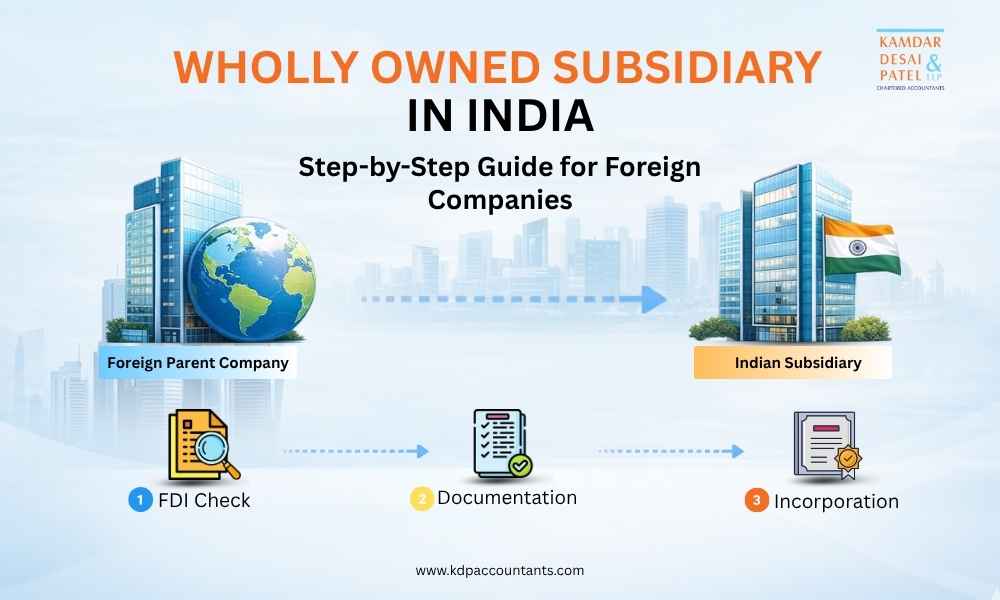
A wholly owned subsidiary in India is an Indian incorporated company whose shares are held 100% by the foreign parent, subject to FDI rules, sector conditions, and investor-profile checks. It gives the overseas parent full equity ownership while keeping the Indian company legally separate for hiring, contracting, invoicing, and scaling.
A WOS in India is usually preferred when the foreign group wants a real operating vehicle instead of a limited representative presence. It creates a local legal entity under the Companies Act while preserving parent-level ownership control.
How is a WOS different from a branch office or liaison office?
Under the Companies Act, a WOS is an Indian company. Under RBI and FEMA guidelines, a branch office or liaison office is a foreign entity that has a presence in India. A liaison office can't make money or do business in India, and a branch office can only do business in a smaller area.
| Structure | Ownership / Control | Separate Legal Entity | Revenue-Generating Ability | Best Use Case |
|---|---|---|---|---|
| Wholly owned subsidiary in India | Full foreign-parent ownership, subject to FDI rules | Yes | Yes | Long-term operations, hiring, contracting, scalable India presence |
| Branch Office | Foreign entity controlled | No | Yes - Limited to permitted activities | Specific operating presence where branch rules fit the business |
| Liaison Office | Foreign entity controlled | No | No | Market presence, coordination, communication only |
For most groups planning long-term India operations, a WOS is more flexible than a representative office structure. It supports commercial contracts, local staffing, and broader operational activity in a way a branch office or liaison office often cannot.
Can a foreign company set up a wholly owned subsidiary in India?
Usually, yes. A foreign company can set up a WOS in India if the proposed activity is eligible under India's FDI regime, the ownership level is permitted, and the investor profile does not trigger additional approval. The key checks are sector caps, automatic route vs government route, and Press Note 3 sensitivity.
Before starting the incorporation file, the foreign parent should confirm whether the planned business activity allows the intended ownership structure. The real first question is not whether a company can be incorporated, but whether the sector and investor profile support that exact foreign company registration India plan.
What minimum requirements apply to incorporate a WOS in India?
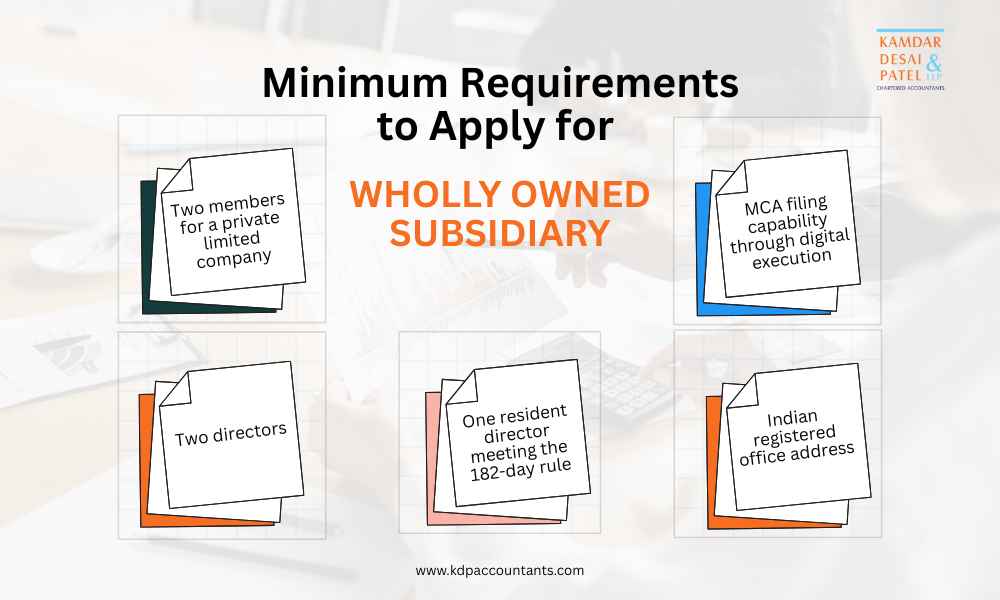
Most foreign companies set up a WOS in India as a private limited company. This usually means that there are at least two members, two directors, and one resident director who has lived in India for 182 days during the financial year. The business also needs a real registered office and the ability to file documents online through the MCA.
- Two members for a private limited company
- Two directors
- One resident director meeting the 182-day rule
- Indian registered office address
- MCA filing capability through digital execution
On paper, these requirements seem easy, but groups from other countries normally need to work together before they can file. Early on, legal, financial, and local representation arrangements should all be in sync so that the incorporation procedure doesn't become stuck at the execution stage.
What documents does a foreign parent need to incorporate a subsidiary in India?
A foreign parent usually needs corporate formation records, board approval documents, authorised signatory papers, identity documents, registered office proof, and legalised foreign-origin attachments. In many cases, documents must be notarised, apostilled, or consularised, and any non-English records must be supported by certified English translations before MCA filing.
The filing itself is often not the slowest step. The real delay usually comes from collecting overseas documents in the correct format and ensuring the authentication method is acceptable for use in India.
Which parent company documents are usually required?
The parent company usually needs its certificate of incorporation, charter or constitutional documents, a board resolution approving the India subsidiary, and authority papers for the authorised signatory. If the Indian entity name uses a group brand, a trademark or brand NOC may also be required for the MCA filing package.
- Certificate of incorporation or registration of the foreign parent
- Charter or constitutional documents such as memorandum, articles, bylaws, or equivalent
- Board resolution approving the India subsidiary and authorised signatory
- Power of attorney or other authorisation papers
- Brand or trademark NOC, where the Indian company name uses group identity
These documents show the Registrar who the parent entity is, who is authorised to act, and whether the foreign parent has properly approved the India incorporation. Missing or inconsistent authority papers are a common cause of delays.
Which director and shareholder documents are usually required?
Foreign individual directors or subscriber representatives usually need a passport, address proof, identity and photograph records, and applicable director declarations or KYC documents. The exact set depends on who becomes a director, who signs for the parent, and whether the execution happens outside India or while physically in India.
- Passport
- Address proof
- Identity and photograph records
- Director declarations or KYC records, where applicable
- India execution context documents, if something is signed while in India
The document pack changes slightly depending on the signatory structure and the role each person is playing in the incorporation. That is why teams should finalise signatories before document collection begins.
Which registered office documents are usually required?
The registered office usually requires a lease deed or rent agreement, a recent utility bill, and a no-objection certificate from the premises owner where applicable. These documents establish the company's statutory address for MCA, tax, and official correspondence from the start of the incorporation process.
- Lease deed or rent agreement
- Recent utility bill
- No-objection certificate, where applicable
This is often treated as a routine item, but it matters because the registered office becomes the official address for the Indian company. If the address proof is not clean, the incorporation file can slow down.
CTA: Need a document checklist first? Chat on WhatsApp and share your parent-company country and planned India activity.
How do you incorporate a wholly owned subsidiary in India step by step?
A wholly owned subsidiary in India is usually incorporated by first checking FDI eligibility, then finalising shareholders and directors, preparing legalised foreign documents, reserving the name, filing through MCA SPICe+, and completing post-allotment FEMA reporting such as FC-GPR. The filing is digital, but cross-border document readiness drives the timeline.
- Confirm structure and FDI eligibility.
Check whether the activity permits 100% foreign ownership, whether the automatic route applies, and whether any investor-country restriction changes the route. This should be done before drafting the incorporation pack. - Finalise shareholders, directors, and resident-director coverage
A private company generally needs two members, two directors, and at least one resident director. This is often the first internal approval stage for the foreign parent. - Prepare parent-company approvals and authorisation papers.
The foreign parent should issue a board resolution and authorisation in favour of the person handling the India setup. If the signatory is overseas, execution should be planned with notarisation and apostille requirements in mind. - Reserve the company name.
The proposed name is checked and reserved through the MCA incorporation workflow. Name strategy matters where the India entity is intended to align with an existing global brand. - Prepare the incorporation pack.
This includes charter documents, registered-office proof, identity records, declarations, and all required legalised foreign-origin attachments. Any non-English document must be supported by a certified English translation. - File through MCA's integrated route
India uses an integrated incorporation process through SPICe+ and linked forms. This route generally combines company incorporation with PAN and TAN allotment. - Receive the certificate of incorporation and tax identifiers
Once approved, the company receives its Certificate of Incorporation and linked tax registrations. At that point, int the Indian entity legally exists, but compliance steps remain. - Open bank account, infuse capital, and complete foreign investment reporting.
After share issuance to the foreign investor, the company must handle FEMA reporting, including FC-GPR, through the reporting architecture built around the FIRMS platform and Single Master Form environment.
The steps are sequential for a reason. If the structure, signatories, or document format are not settled early, later stages such as SPICe+ filing and foreign investment reporting become harder to manage cleanly.
What compliance should foreign companies plan after WOS incorporation?
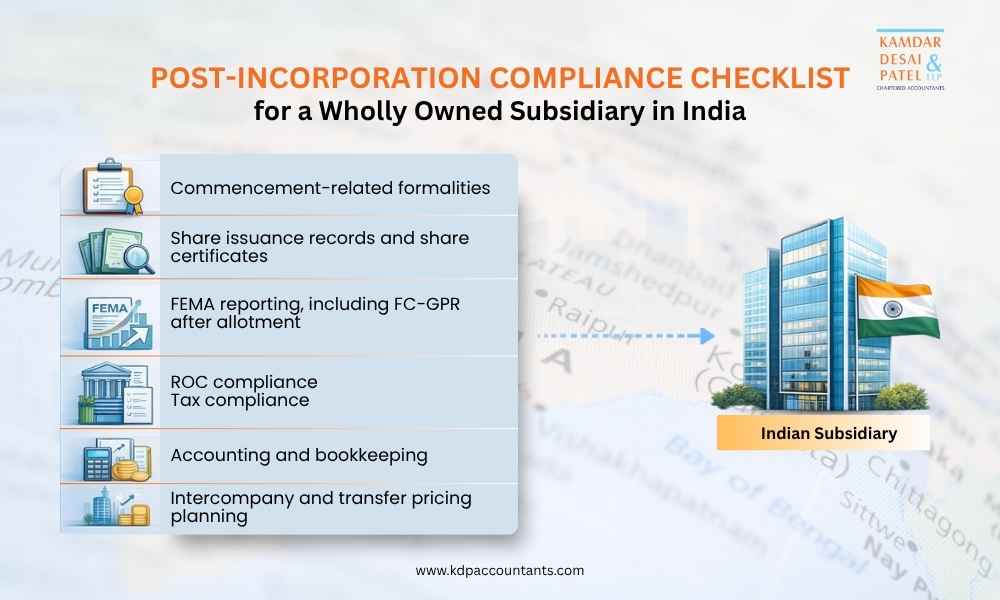
After incorporation, the Indian subsidiary still needs share issuance records, commencement-related formalities, FC-GPR and other applicable FEMA reporting, plus ongoing ROC, tax, accounting, and intercompany compliance. If the wholly owned subsidiary transacts with the foreign parent for services, IP, or support charges, transfer pricing becomes an early planning issue.
- Commencement-related formalities
- Share issuance records and share certificates
- FEMA reporting, including FC-GPR after allotment
- ROC compliance
- Tax compliance
- Accounting and bookkeeping
- Intercompany and transfer pricing planning
This is where many foreign groups underestimate the ongoing work. The wholly owned subsidiary in India process does not end with the certificate. The company must remain compliant after capital infusion, share allotment, and operational launch.
How long does WOS incorporation take, and when should a foreign company get help?
For most foreign groups, the filing stage is not the main bottleneck. Timelines usually depend on FDI feasibility review, readiness of parent-company approvals, legalisation of overseas documents, and coordination across time zones. Professional help adds the most value early, when the structure, signatories, and document format are still being decided.
The best time to get support is before documents are signed and before the incorporation pack is finalised. That is when advisers can prevent avoidable errors in FDI route assessment, MCA filing sequence, and FEMA or RBI planning.
Planning a wholly owned subsidiary in India? Share your parent-company jurisdiction and business activity on WhatsApp for a quick feasibility and document checklist.
FAQ
Can a foreign company own 100% of a subsidiary in India?
Yes, in many sectors a foreign company can own 100% of an Indian subsidiary, often under the automatic route, but the answer always depends on sector caps, investment conditions, and the investor profile. The ownership position must be checked against the relevant FDI rules before incorporation begins.
What documents must be apostilled for WOS incorporation?
Foreign-origin subscriber records, identity papers, signatures on incorporation documents, and parent-company authorisation records commonly require notarisation and apostille, or consularisation where apostille is unavailable. If the source documents are not in English, certified English translations are also usually required for the India incorporation package.
Is a WOS better than a branch office for long-term operations?
Usually, yes. A wholly owned subsidiary is generally better for long-term India operations because it is an Indian incorporated company that can support hiring, contracting, invoicing, and scalable activity. A liaison office cannot do business or earn income, and a branch office operates within narrower permitted activity limits.
What filings apply after incorporation of a WOS in India?
After incorporation, common next steps include share issuance documentation, FC-GPR and other applicable FEMA reporting, plus ongoing ROC, tax, accounting, and intercompany compliance. If the Indian subsidiary transacts with the foreign parent, transfer pricing should be reviewed early rather than treated as a later cleanup issue.