


Private Limited vs LLP vs OPC in India: Which Structure Fits Your Startup in 2026?

Choosing the wrong legal structure can slow a startup down before it even begins. In India, your choice impacts how easily you can raise capital, the level of compliance you’ll handle each year, who can legally own the business, and how profits are taxed. For most founders in 2026, the real decision comes down to three formats: Private Limited, LLP, and OPC.
The good news is that this choice doesn’t have to be confusing. Whether you are a solo founder, a bootstrapped partnership, or an NRI entrepreneur, the right structure usually becomes clear when you evaluate four key factors—your fundraising plans, the number of founders, your comfort with compliance, and whether you need a formal shareholding structure from day one.
The quick answer:
- Choose an OPC if you are a solo founder who wants limited liability and company credibility, but you do not expect a co-founder or equity investor immediately.
- Choose an LLP if you have two or more founders, run a service-led or consulting business, and want a lighter compliance burden.
- Choose a Private Limited Company if you plan to raise angel or VC funding, issue ESOPs, or build a venture that needs a clean equity structure.
Fast founder filter:
Solo and not fundraising yet? OPC
Two or more partners and keeping it lean? LLP
Building for scale, equity, and investors? Private Limited
Comparison table: Private Limited vs LLP vs OPC
| Factor | Private Limited Company | LLP | OPC |
|---|---|---|---|
| Owners | 2 to 200 members | Minimum 2 partners | 1 member |
| Management | Minimum 2 directors, max 15 | Minimum 2 designated partners | 1 director minimum |
| Resident requirement | At least 1 director staying in India for 182 days in the financial year | At least 1 resident designated partner, 120 days in India during the financial year | OPC eligibility opened to Indian citizens whether resident in India or otherwise |
| Compliance load | Highest of the three | Usually lighter | Moderate, but still company-style compliance |
| Audit position | Company audit framework applies | Audit generally kicks in above ₹40 lakh turnover or ₹25 lakh contribution | Company audit framework applies |
| Fundraising fit | Best for equity, ESOPs, and institutional capital | Weak for equity fundraising | Limited in practice until conversion |
| Best for | Scalable startups, funded ventures | Agencies, consultants, professional firms | Solo founders |
| Conversion flexibility | Already built for scale | Can continue as LLP or restructure later | Can convert anytime after 2021 changes |
The legal counts, residency rules, OPC rule changes, and tax or compliance signals above come from the Companies Act, the LLP Act, MCA's 2021 OPC reforms, LLP Rules, and current Income Tax Department guidance.
What each structure actually means
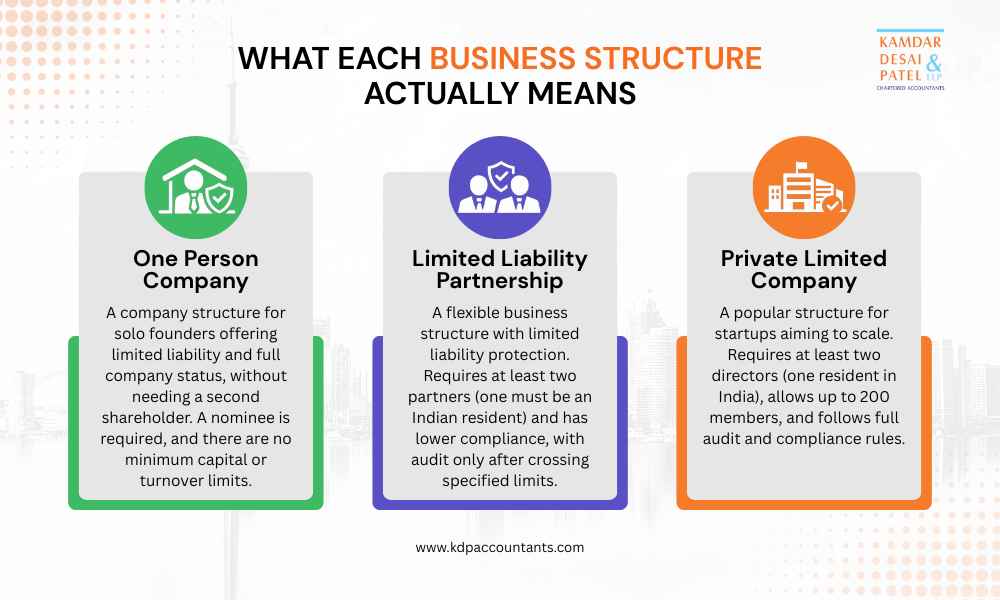
Before you choose between Private Limited vs LLP vs OPC in India, you need to understand what each structure actually gives you in real business terms.
What is an OPC?
An OPC, or One Person Company, is designed for solo founders who want a formal business structure without adding a second shareholder just to complete incorporation. In the Private Limited vs LLP vs OPC comparison, OPC stands out as the single-founder option with limited liability and company status. It still requires a nominee, and since 1 April 2021, an Indian citizen can incorporate an OPC whether resident in India or otherwise. The same reform also removed the old paid-up capital and turnover limits that once triggered mandatory conversion.
What is an LLP?
An LLP, or Limited Liability Partnership, is a separate legal entity that combines partnership-style flexibility with limited liability protection. It must have at least two designated partners, and at least one of them must be resident in India. For many service firms, one of the big advantages is lighter ongoing compliance compared with a company, especially because audit is generally not mandatory until the LLP crosses the turnover or contribution thresholds in the rules.
What is a Private Limited Company?
A Private Limited Company is the standard startup vehicle for founders who want scale. Under the Companies Act, a private company needs at least two directors, can have up to fifteen directors without special expansion, and limits the number of members to two hundred. It also needs at least one resident director who stays in India for 182 days during the financial year, and companies operate under the full company audit and filing framework.
Pro tip: A lot of founders compare Private Limited vs LLP vs OPC in India only on setup ease or yearly compliance. In practice, the better question is what this business may need next — whether that is co-founders, outside funding, or more formal compliance later. Choosing with that longer view usually saves a lot of backtracking.
Which structure fits which founder?
When it comes to Private Limited vs LLP vs OPC in India, the best structure changes with your funding plans, team size, and growth goals.
Best structure for a solo founder in India
If you are building alone, an OPC is often the strongest starting point in the Private Limited vs LLP vs OPC decision. It gives solo founders limited liability, a separate legal identity, and stronger credibility than a sole proprietorship. But if you already expect a co-founder, ESOPs, or investor interest soon, starting as a Private Limited Company may be the smarter move because it avoids a later conversion.
Best structure for two co-founders or a service business
For two founders building a consulting firm, agency, studio, or professional practice, LLP is usually the most practical option. It gives limited liability and a separate entity, but avoids some of the heavier company-style governance that a Private Limited Company brings. That makes LLP especially attractive when the business will be bootstrapped, client-funded, and unlikely to issue equity soon.
Best structure for a startup planning to raise funding
If your roadmap includes angel funding, venture capital, ESOPs, or multiple classes of ownership, Private Limited is usually the right structure from day one. In practice, investors are far more comfortable with a company that has a share-based ownership model than with an LLP, because governance, equity allocation, and exits are easier to structure. This is the strongest reason many startup lawyers and incorporation advisors push funded startups toward Private Limited.
Best structure for an NRI founder
This is where the Private Limited vs LLP vs OPC decision gets more nuanced for NRI founders. An NRI who is an Indian citizen can incorporate an OPC after the 2021 reform, but that does not make OPC the right fit for every NRI-led business. If you are not an Indian citizen, OPC is not available. And even with a company or LLP, India still requires local residency roles, such as a resident director for a company and a resident designated partner for an LLP. For many NRI founders building a serious multi-owner startup, a Private Limited Company is usually the more practical choice.
Pro tip: If the founders are based outside India, do not treat structure selection as a form-filling choice. Things like resident-role requirements, Indian address readiness, foreign documents, and later RBI or compliance obligations can shape what is actually practical, even when one structure looks simpler on paper.
One-person company vs sole proprietorship: what solo founders should know
This is one of the most important comparisons for freelancers and first-time founders. A sole proprietorship is simple and fast, but it does not give you a separate legal entity. In a proprietorship, the owner and the business are effectively the same for liability purposes. By contrast, an OPC has separate legal status, limited liability, and perpetual succession through the nominee structure. It also carries more formal filings and company compliance.
So which one wins? If you are just testing a tiny, low-risk side hustle with almost no contracts, employees, or borrowing, a proprietorship may still be enough for the early phase. But if you want brand credibility, limited liability, better positioning with clients, and a cleaner path to future scale, OPC is the stronger structure for a serious solo founder in India.
LLP vs private limited company India: the real trade-off
The real difference between LLP and Private Limited is not just legal form — it is what kind of business you are actually building. An LLP is usually better when you want operational simplicity, partner flexibility, and lower routine compliance. It works well for service-led businesses where profits are distributed to founders and outside equity is not the plan. The lighter audit trigger is a practical advantage for smaller businesses that stay below the prescribed thresholds.
A Private Limited Company is better when ownership structure matters. If you want to split equity carefully, create vesting, issue ESOPs, onboard investors, or build for acquisition, the company format is the stronger vehicle. Yes, the compliance burden is heavier, but you are paying for a structure that is far more compatible with scale.
Taxation in 2026: why Private Limited vs LLP vs OPC is not just a tax decision
Founders often try to choose a structure based only on tax rate, and that is a mistake. According to the Income Tax Department's current rules, LLPs are usually taxed at 30% plus any applicable surcharge and cess. Domestic firms, on the other hand, may be taxed at 25% or 22% under section 115BAA, depending on the circumstances. That can make a company look better on paper, but the real result relies on how you take money out, how much you reinvest, and whether you need deductions or flexibility. Structure should be chosen for strategy first, and tax only second.
2026 mistakes founders should avoid
Do not choose an LLP if you already know equity funding is part of the plan. Do not choose an OPC if you expect to add a co-founder soon. Do not rely on old blog posts that still mention the pre-2021 OPC turnover and paid-up capital restrictions, because those were removed. And if you are an NRI founder, do not ignore the local residency roles that still apply to companies and LLPs in India.
Final verdict
If you want the simplest way to decide Private Limited vs LLP vs OPC, use this rule:
Solo founder + limited liability + no immediate investor = OPC
Two or more founders + service model + lower compliance = LLP
Scalable startup + funding ambition + equity planning = Private Limited
In the Private Limited vs LLP vs OPC comparison, Private Limited is usually the default winner for long-term scale and fundraising. LLP works best for lean professional or service-led businesses. OPC remains a smart 2026 choice for solo founders who want a real company structure without adding a placeholder co-founder.
Before you file, speak with an incorporation expert, especially if you are an NRI founder or expect fundraising within the next 12 months.
Frequently Asked Questions
Can an NRI start an OPC in India?
Yes. In the Private Limited vs LLP vs OPC in India context, an NRI can start an OPC only if the person is an Indian citizen. Since the 2021 MCA reform, an Indian citizen, whether resident in India or otherwise, can incorporate an OPC.
Is LLP better than a private limited company in India?
It depends on the business model. In LLP vs private limited company India, LLP is usually better for lean service firms that want lower compliance, while Private Limited is better for startups planning equity funding, ESOPs, or scale.
Is OPC better than sole proprietorship?
Usually yes for serious solo founders. In one person company vs sole proprietorship, OPC offers a separate legal entity, limited liability, and stronger business credibility. A sole proprietorship can still work for a tiny, low-risk test business with minimal compliance needs.
Which structure do investors prefer in India?
In the Private Limited vs LLP vs OPC in India comparison, investors usually prefer a Private Limited Company. It has a clear shareholding structure and is better suited for equity investment, ESOPs, and future fundraising than LLP or OPC.
Can an OPC raise funding later?
Yes, but usually after conversion. In Private Limited vs LLP vs OPC in India, an OPC can be converted into a Private Limited Company when outside funding becomes relevant. Since 2021, voluntary conversion is allowed at any time.
What is the best structure for a solo founder in India?
For most founders, the best structure for a solo founder in India is OPC if they want limited liability and company credibility without adding a co-founder. If rapid fundraising is likely soon, starting as a Private Limited may be more practical.