


GST Registration Documents Required in India: Complete Guide for Businesses
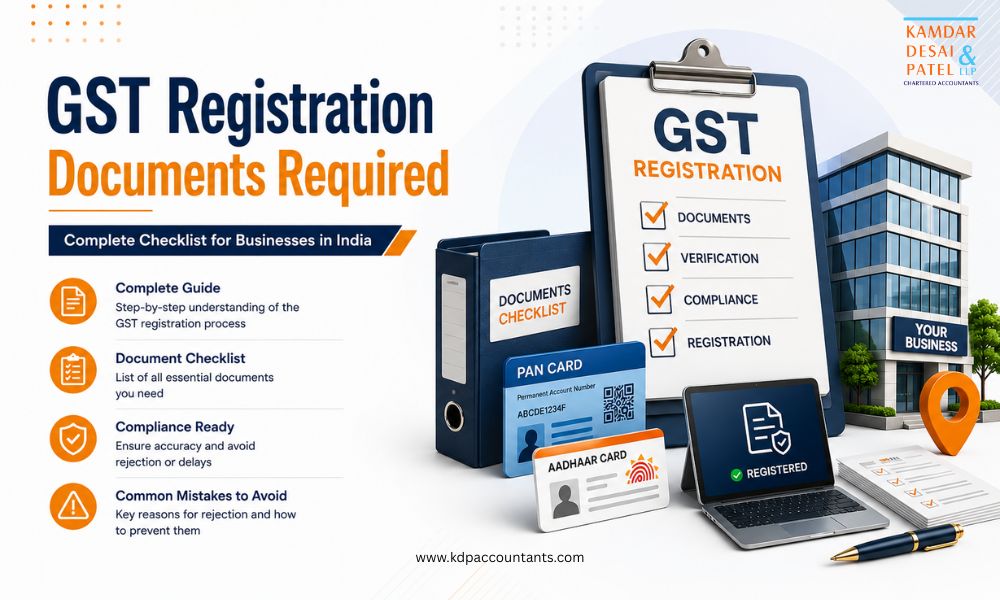
Starting a business in India is easy, but running it professionally starts with proper compliance. One of the most important registrations for any business in India is GST Registration. Whether you are a startup, trader, freelancer, manufacturer, service provider, or e-commerce seller, GST registration helps your business operate legally and grow with confidence.
Many businesses think GST is only for large companies, but in reality, even small and growing businesses choose GST registration to build trust, claim tax benefits, and work with bigger clients.
Documents Required for GST Registration
At the time of GST registration, business must have following list of documents ready:
- PAN of the Company/ Firm/ Applicant seeking GST Registration
- Certificate of Incorporation / Partnership Deed / LLP Agreement
- PAN, Aadhaar Card & Passport Size Photograph of Directors / Partners / Proprietor
- Email ID & Mobile Number of Directors/ Partners/ Proprietor
- Board Resolution / Authorization Letter for Appointment of Authorised Signatory
- PAN, Aadhaar, Photograph, Email ID & Mobile Number of Authorised Signatory (if different from Director/ Partner)
- Check nature of Business Premises & collect address proof as applicable
- Nature of Business / Goods / Services
- Bank Account Details (Cancelled Cheque / Bank Statement, if required)
- Aadhaar linked Mobile Number for Aadhaar Authentication
- Check whether Profession tax registrations has been obtained for the entity as per state-wise applicability
Although GST registration is an online and streamlined process, many applications are rejected or marked for clarification due to incorrect, incomplete, or insufficient Proof of Principal Place of Business documents. This article explains the admissible proof of place of business for GST registration.
For GST registration, proof of place of business becomes very critical as the documents required vary based on the nature of premises operated on, whether owned, leased/sub-leased, procured on consent /rent-free basis.
(a) For Owned Premises
Any valid document establishing ownership of the business premises may be submitted, such as the latest Property Tax Receipt, Municipal Khata Copy, Electricity Bill, or similar government-issued property document. These documents help verify the address and confirm the legal possession of the premises for GST registration purposes.
(b) For Rented or Leased Premises
A valid Rent Agreement or Lease Agreement must be submitted along with supporting ownership proof of the property owner, such as the latest Property Tax Receipt, Municipal Khata Copy, Electricity Bill, or any other government-recognized address document. A registered L&L is preferred over a notarised rent agreement. In case of premises procured through sublease or in co-working spaces, it is necessary to produce chain of agreements to establish the lawful use and occupancy of the premises for business and GST registration purposes. In addition to this, a signed NOC(s) in favour of applicant shall be submitted.
(c) For Consent / Shared Premises Not Covered Under (a) and (b)
Where the premises are neither owned nor rented by the applicant, a signed NOC/Consent Letter along with ownership proof (Electricity Bill, Property Tax Receipt, or Khata Copy) must be submitted. The same applies to shared or family-owned properties
Earlier, GST authorities often required a notarized NOC or stamp paper declaration. However, as per Notification No. 12/2024-Central Tax dated 10.07.2024, a simple signed NOC or Consent Letter is now generally sufficient for GST registration.
(d) For SEZ Units / Developers
Where the principal place of business is located in an SEZ or the applicant is an SEZ Developer, valid approval or certificate issued by the Government of India / SEZ authority must be uploaded for GST registration.
Other Common Reasons for GST Registration Rejection
Commonly, the GST registration applications may get rejected on account of incorrect or mismatched PAN details, legal name not matching the PAN database, uploading unclear/invalid/blurred documents, incomplete or incorrect Principal Place of Business address or insufficient document proof to establish lawful use and occupancy of business premises.
Also, failure to complete Aadhaar authentication or bio-metric verification may lead to rejection or delay in the registration application. It may also lead to your application being flagged as high-risk. Therefore, it is important for the applicant and authorised signatory to complete Aadhaar authentication within the prescribed time to avoid unnecessary compliance issues.
Registration under Profession Tax Act
The applicant is required to obtain registration (PTEC/PTRC) as applicable as the same may be asked by GST authorities while processing GST registration applications. The applicability of each such registration under Profession Tax Act is discussed below:
- PTEC for Company: PTEC (Professional Tax Enrolment Certificate) is required for companies and professionals liable to pay professional tax on their own behalf.
- PTEC for Directors: It should also be checked whether the directors have obtained their individual PTEC registration, as directors receiving remuneration or being liable under the PT provisions may be required to obtain separate enrolment in their individual capacity.
- PTRC: PTRC (Professional Tax Registration Certificate) is required for employers who employ staff or employees. Under PTRC, the employer is responsible for deducting professional tax from employee salary and depositing the same with the state government within the prescribed due dates.
Bank Account details to be submitted post obtaining GST registration
Once the GST application is approved and GST number is granted, the applicant is required to update bank account details on GST portal within 30 days of approval or before first GST return filing. A cancelled cheque, bank statement, or passbook copy is accepted as valid document for such bank account updation. Without such amendment made, the GST portal does not allow any GST filings. Also, failure to comply with this may lead to suspension or cancellation of GST Registration by GST authorities.
Conclusion
While the registering process is fully online, submitting right documents and complying with the latest GST requirements can significantly reduce the chances of receiving notices or application rejection.
At KDP, we ensure all the documents are complete, Aadhar authentication is completed within the prescribed timelines, and other applicable registrations such as Profession tax are obtained wherever required. For professional assistance with GST registration, document verification, reach us at enquire@kdpaccountants.com, our team is here to help.
FAQs
What are the documents required for GST registration in India?
Generally you need documents such as, PAN Card, Aadhar card, business documents, address proof of business premises, photographs, bank account details. For more in details contact to enquire@kdpaccountants.com
Why GST registration applicants gets rejected?
There are some common reaosn include, incorrect or mismatched of PAN details, incomplete address proof, failure of Aadhar authentication, or incorrect business information.
Can GST registration be obtained from a residential address?
Yes, GST registration can be obtained from a residential address, provided the necessary ownership documents and address proof and other supporting documents as required.

Vishal Tank
Author
Vishal Tank is a finance and taxation professional with over five years of experience in Indirect Taxation, GST compliance, statutory audits, and regulatory reporting.
He has successfully assisted clients across diverse industries with GST compliance. He specializes in GST registrations, return filings, refund claims, tax assessments, and statutory compliance, helping businesses meet regulatory requirements accurately and efficiently.
Through his writing, Vishal shares practical insights on taxation, compliance, and financial reporting, simplifying complex concepts for businesses, professionals, and aspiring finance practitioners.