


Letter of Undertaking (LUT) Under GST: A Small Filing with a Big Impact on Cash Flow
What is the LUT under GST and How Does it works?
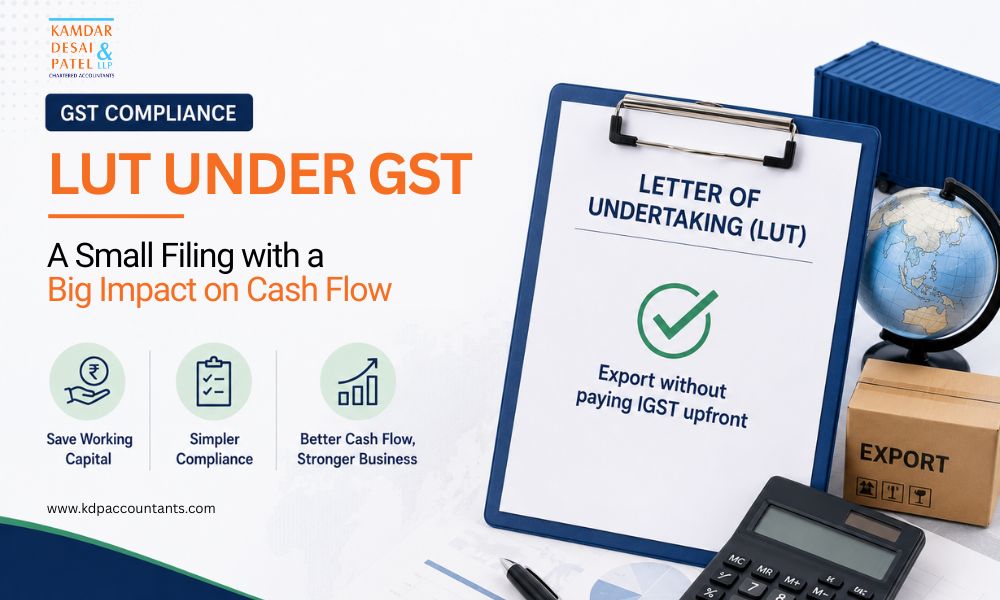
LUT stands for Letter of Undertaking. In simple terms, it is a one-time online declaration you submit on the GST portal that basically tells the government: "I am an exporter, and I promise to comply with GST rules. Please let me export without paying IGST upfront."
Once the LUT is filed and accepted which happens almost instantly you can start exporting goods or services without blocking any money in tax payments. The IGST that would otherwise be due simply does not need to be paid at the time of export.
That is really it. One form, filed once a year, and your cash stays in your hands.
For example:
In a scenario where we worked with a client, they were exporting goods worth ₹50 lakh. GST on that? ₹9 lakh. Without an LUT, here is what the process looked like:
- Pay ₹9 lakh as IGST before the goods even leave the country
- Apply for a refund after the export
- Wait sometimes weeks, sometimes longer for that refund to come back
During that waiting period, ₹9 lakh is just sitting with the government, doing nothing for the business. For a small or mid-sized exporter, that is not a small amount.
With the LUT filed, the client exported without paying that ₹9 lakh upfront. It stayed in their account, available for buying raw materials, paying vendors, or just keeping operations running smoothly. That is the entire point of LUT.
Overview
A Letter of Undertaking (LUT) allows eligible exporters to export goods or services without paying IGST upfront. Since no IGST is paid upfront, businesses can use that money for their day-to-day operations.
It improves cash flow, reduces compliance hassles, and makes export transactions smoother. Missing annual renewal or exporting without a valid LUT can lead to unnecessary compliance delays.
Why an LUT is a Complete Game Changer for Business Owners
Here is exactly how it changes your day-to-day business operations:
Your working capital stays intact:
No upfront payment means the money you would have paid as IGST stays available for actual business use not sitting in a refund queue.
You stop chasing refunds:
Refund claims take time, follow-ups, and paperwork. LUT eliminates that headache entirely for most exporters.
You can price more competitively:
When you are not factoring in the cost of blocked capital, you have a little more room on pricing which matters a lot when you are competing for international.
Who Should Get an LUT?
Goods Exporters:
Any business that sends physical goods outside India can apply for an LUT. With an LUT, they can export without paying IGST upfront.
Service Exporters and Freelancers:
Businesses and individuals who provide services to clients outside India can also file an LUT. Examples include software developers, designers, and other professionals working with overseas clients.
Suppliers to SEZ Units and SEZ Developers:
Supplies made to Special Economic Zones (SEZs) are treated as zero-rated under GST. Businesses that supply goods or services to SEZ units or developers can use LUT to make these supplies without paying IGST first.
Startups and Small Businesses:
For startups and small businesses, managing cash flow is often critical. Instead of paying IGST first and waiting for a refund later, filing an LUT keeps those funds available for day-to-day operations, buying inventory, and future growth.
Quick next step: Exporting goods or services?
File your LUT at the beginning of every financial year and keep your cash flow smooth.
Step 1: Log in to the GST portal.
Step 2: Go to Services > User Services > Form GST RFD-11.
Step 3: Select the Financial Year.
Step 4: Fill in your details and enter the names, occupation, and address of 2 independent witnesses. (Fill all mandatory details)
Step 5: Submit using DSC or EVC (OTP). (Approval is almost instant).
LUT Validity & Deadline (How Long Is It Valid)?
Many exporters wrongly assume that once an LUT is filed, it remains valid forever. However, an LUT is valid for only one financial year (April to March) and must be renewed every year. If not done on time, exporters may have to pay IGST on their exports until a valid LUT is furnished. Therefore, timely renewal of LUT is important to ensure smooth export operations and avoid unnecessary tax payments.
Common Mistakes Exporters Make
Common mistakes include not renewing LUT on time, exporting without a valid LUT, assuming one LUT covers multiple GSTINs, filing incorrect details, and failing to maintain proper export records.
Conclusion:
For exporters, LUT is one of the simplest yet most useful GST compliances. A few minutes spent filing LUT can help save working capital, reduce refund-related hassles, and make export operations smoother throughout the year.
If your business exports goods, services, or supplies to SEZs, filing a letter of undertaking (LUT) at the beginning of every financial year should be part of your compliance checklist. For professional expert guidance, reach us at enquire@kdpaccountants.com.
FAQs
Is there any fee to apply for an LUT on the GST portal?
No, applying for an LUT is 100% free. The government does not charge any processing fees or application fees on the GST portal to file Form RFD-11.
Who can be the two witnesses required during the online filing?
Any two independent individuals can be your witnesses. They can be your friends, family members, employees, or business associates. You just need to enter their names, occupations, and addresses on the portal. They do not need to sign anything physically.
Can LUT also used in case of services?
Yes, absolutely. An LUT can be used for the export of services just as easily as it is used for goods. In fact, it is highly recommended for freelancers, tech startups, agencies, and consultants who serve international clients.
Can a newly registered GST taxpay?
Yes, any newly registered business can apply for an LUT from day one.
What is the turnover requirement for LUT?
There is zero minimum turnover required to file an LUT. Any business, whether it is a brand-new startup making its first export is eligible to file an LUT from day one.
How long does it take for the GST department to approve an LUT?
The LUT approval process is largely automated. Once Form RFD-11 is submitted using DSC or EVC, an ARN is generated instantly, and the LUT is usually accepted immediately.
What happens to the GST I pay on my local purchases (like raw materials or rent) if I use an LUT?
Since you don’t pay tax on exports, your local tax accumulates in your Electronic Credit Ledger as Input Tax Credit (ITC). You can claim a 100% cash refund of this accumulated local tax from the government by filing Form GST RFD-01.
Can an LUT be rejected by the tax department?
An LUT is rarely rejected. The only scenario where you can be denied an LUT is if you or your company directors have been legally prosecuted or convicted for tax evasion of ₹2.5 Crores or more under the GST or existing laws.
Can I modify or edit an LUT after submitting it on the portal?
No, once an LUT is successfully submitted on the GST portal, it cannot be edited or modified.you must file a fresh, new LUT with the correct details. The portal allows you to file a new one even if an old one exists.
Can one LUT cover multiple Branches with different GST number?
No. An LUT is tied strictly to a specific GSTIN. If your company has multiple GST registrations across different states, you must file a separate LUT for each registration.
Raj Goswami
Author
Raj Goswami is a finance and taxation professional with over three years of experience in Indirect Taxation, Direct Tax, and statutory compliance. He helps businesses navigate tax regulations with practical, accurate, and compliance-focused solutions.
Passionate about sharing knowledge, writes on GST, taxation, and finance to make complex topics simple and actionable.