


E-Invoice & Compliance in India: Applicability, Penalties, & Key Business Risks
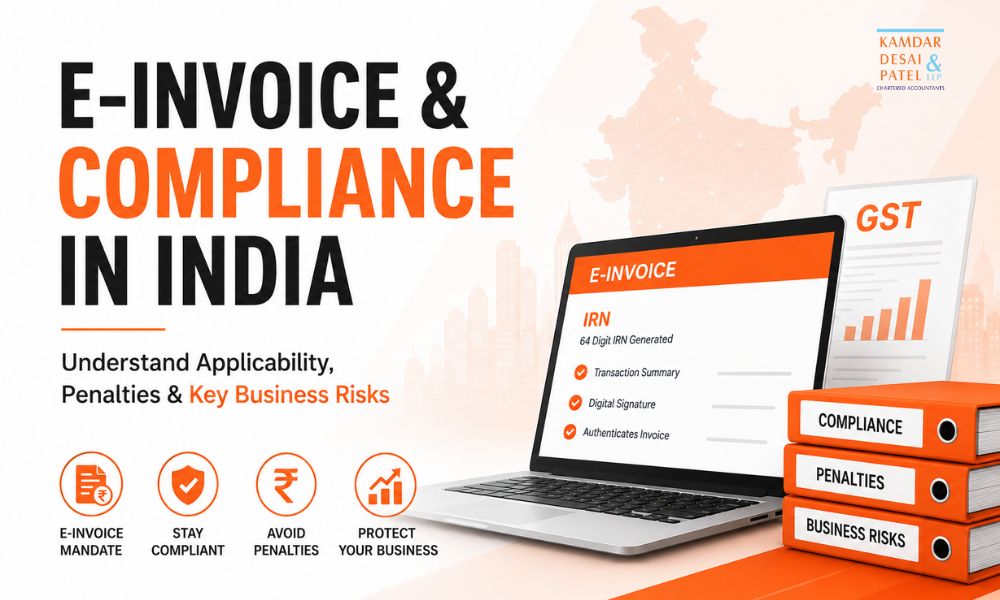
E-Invoice under GST was initially applicable for entities having the Annual Aggregate Turnover (AATO) exceeding INR 500Cr from October 2020. Later, the GST E-Invoice threshold limit was reduced to INR 5Cr from August 2023 for other than B2C invoices.
Applicability & Exclusion:
As per GST E-Invoice rules, any GST registered party having the AATO exceeding INR 5 Crore in any financial year starting from 2017-18 (across all the GSTIN under one PAN) must generate the E-invoice for all the supplies other than B2C.
Also, certain business entities such as banks/financial institutions, insurance companies, SEZ supplier, Good Transport Agencies (GTA’s) etc. are excluded from mandatory e-invoicing compliance irrespective of their AATO.
How to verify the authenticity of the E-Invoice:
There are 3 key factors such as IRN, QR Code & Digital signature which authenticate the E-invoice.
- IRN: IRN is the 64-digit unique code generated by the ‘Invoice Registration Portal’ (IRP).
- QR Code: QR code on an invoice is consist of transaction summary.
- Digital Signature: The digital signature is the official validation of the document which states that the document is original and not tampered.
Monetary Penalty:
| Compliance Violation | Penalty |
|---|---|
| Non-Issuance of E-Invoice | INR 10,000 per Invoice or 100% of tax liability, whichever is higher |
| E-Invoice generation incorrectly (GSTN mismatch, duplication of invoice etc.) | Up to INR 25,000 per Invoice. |
| Incorrect ITC claimed by buyer on invalid e-invoice | 100% of ITC claimed along with 18% interest |
Failure to comply with E-Invoice compliance in India can result in penalties and tax consequences under GST regulations.
Non-Monetary Penalty:
Since e-invoice & e-way bills are integrated, an invoice generated without QR code & IRN is legally invalid hence, the e-way bill is also considered as invalid. Goods transported under such cases can be detained by the regulatory authorities which simultaneously results in seize of the vehicle. Further, this would result in non-compliance of the e-way bill, which attracts penalties for the same.
Implications from the Business point of view:
Failure in issuing an e-invoice to the customer, can make the invoice legally invalid even though the details mentioned in the invoice is accurate. Buyer cannot claim the ITC as the invoice gets invalid. The buyer has already paid GST to the supplier, but the ITC for the same is permanently lost due to which buyer may demand a refund and/or refuse the delivery. Buyer may terminate ongoing and future contracts with the supplier which results in long-term business losses (following is the example for better understanding).
Example: Party A (supplier) supplied goods worth INR 1Cr to Party B (buyer) which is an established entity and follows all legal compliances & regulations. The supplier forgot to generate an e-invoice and goods were transported with a supporting of e-way bill. Upon delivery of the goods, the buyer noticed the invoice issued by the supplier is not generated via the e-invoice portal. In this regard, the buyer rejected the delivery of the goods and black listed the supplier in their records, followed by the termination of the contract and business loss.
Measures:
While generating an e-invoice, two-factor authentication shall be implemented for every invoice generation through maker-checker role. AATO shall be monitored periodically. It is important to have the right team on board to avoid such non-compliance and losing out on any business opportunity arising in the future.
E-Invoice has become an essential compliance part under the GST framework. All businesses must ensure that invoices are generated through the Invoice Registration Portal (IRP) and should contain a valid IRN and QR code.
At KDP Accountants, we assist businesses with GST compliance, tax advisory, and regulatory reporting requirements. For quick assistance, connect with us at enquire@kdpaccountants.com to minimize risks and ensure smooth business operations.
FAQs
What is an E-Invoice in GST?
An e-invoice in GST is electronically authenticated through the IRP and assign a unique Invoice Reference Number (IRN).
What is an IRN in an e-invoice?
Invoice Reference Number (IRN) is a unique 64-character number generated by the Invoice Registration System to validate an e-invoice.
Who is required to generate an e-invoice under GST?
- Businesses with an Annual Aggregate Turnover (AATO) over INR 5 crore in any financial year from FY 2017-18 onwards.
- Mandated to generate e-invoices for B2B transactions.
What happens if an invoice is issued without an IRN and QR code?
If you issue an e-invoice without valid IRN and QR Code, the invoice will be completely invalid under GST laws and you may face penalties for non-compliance.

Sahil Gade
Author
Working as an Accounts and Compliance Professional with over 5 years of experience in managing accounting, taxation, and regulatory compliance functions for multiple clients. Currently serving as “Executive – Accounts & Compliance”, handling end-to-end accounting processes, financial reporting, GST compliance, TDS compliance, E-Invoice & E-Way Bill management for clients.
Having hands on expertise in accounting in various software like Tally, Netsuit, ZIP ERP, includes GST compliance consisting return filings, reconciliations, E-invoicing & E-way bill management.