


Softex Compliance for Software Exporters: What Every IT Business Must Know
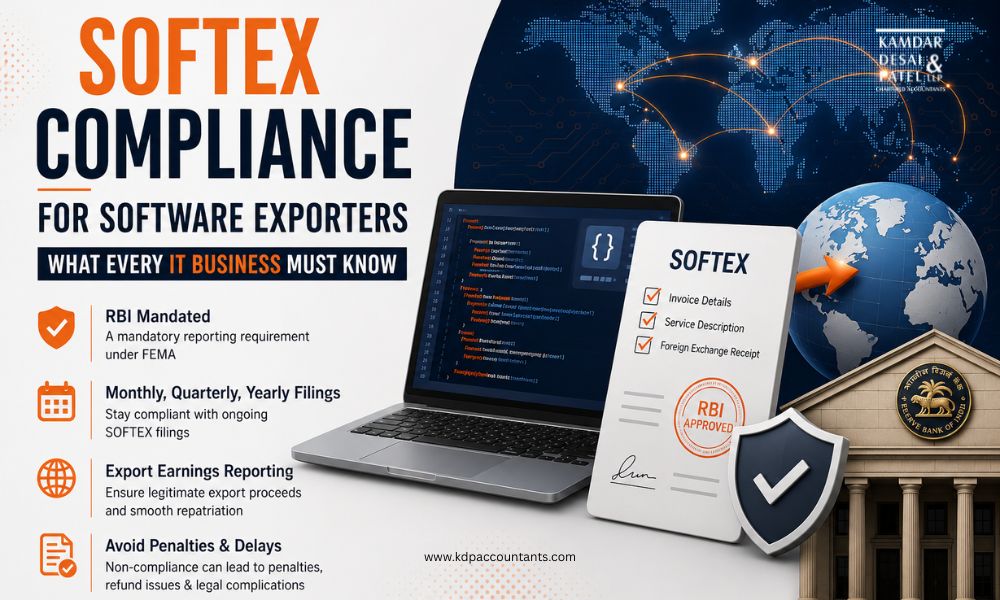
Most Indian IT companies and freelancers don't realise they have a mandatory obligation under FEMA every single month. Here's what you need to know.
The compliance most IT exporters quietly miss
Every year, thousands of Indian software companies, IT service firms, and freelance developers export their services to clients abroad, receive foreign currency payments, and assume their banking and GST obligations are enough. For many of them, there is one more layer, a specific RBI reporting requirement called Softex that quietly remains outstanding.
It is not that exporters are trying to avoid compliance. Most simply have not been told this requirement applies to them. And when it is discovered, sometimes years later, during a regulatory review or when a banker flags it the gaps can be significant.
This post explains what Softex is, who needs to comply, and what the compliance cycle looks like. It is a first map, one that tells you whether this is something you need to sit down with an advisor about.
What Is the Softex Filing, And Why Does It Exist?
India's foreign exchange framework, governed by Foreign Exchange Management Act (FEMA), requires that any earnings from exports be reported to the Reserve Bank of India. For goods, this happens through shipping bills processed at customs. For software and technology services, which have no physical shipment, the mechanism is different. That mechanism is the Softex form.
Softex form is the RBI-mandated declaration that a software or IT services exporter must submit to certify that a foreign currency receipt represents a legitimate export transaction, the nature of the service, the value invoiced, and the remittance received.
The purpose is straightforward: to ensure that export earnings are brought back into India, declared accurately, and recorded in the country's balance of payments data. In that sense, Softex is not punitive regulation, it is the reporting architecture that makes software export proceeds legitimate under FEMA.
Who needs to file Softex Forms?
The requirement applies to exporters of software, IT-enabled services, and related technology services.
If you receive foreign exchange for any service that could reasonably be described as software, technology, or IT-enabled, the starting position should be that Softex may apply, until confirmed otherwise.
What filings are involved, and when?
Softex compliance is not a one-time event. It is an ongoing regulatory programme with filings at three different frequencies.
Every month
A SOFTEX form must be filed within 30 days of the last export invoice raised in a month.
Every quarter
A performance report covering your export activity for the quarter must be submitted to your jurisdictional STPI centre.
Every year
An Annual Performance Report summarising the full year's export data is due by 30 June.
What Happens When Softex Is Not Filed?
Under FEMA, failure to file Softex, or significant delays in doing so, constitutes a foreign exchange violation. The consequences are not theoretical: they include penalties under FEMA, difficulty in repatriating accumulated export earnings, complications in GST refund claims (which are linked to export documentation), and exposure during FEMA audits or ED enquiries. FEMA violations carry operational consequences and they compound over time.
If you have missed filings for prior years, the situation requires careful remediation, a process that involves STPI back-certification, possible RBI compounding applications, and bank-level reconciliation. The longer it is left, the more complex and costly it becomes.
Where we come in
SOFTEX sits at the crossroads of FEMA law, RBI circulars, STPI procedures, GST compliance, and banking, each with its own deadlines, formats, and points of failure. Our firm manages this entire compliance lifecycle on your behalf.
Compliance health check
We assess your current position, whether you're fully compliant, have gaps, or are carrying historic exposure that needs to be addressed.
Registration & onboarding
We handle your STPI registration and DSC setup, the foundation without which nothing else works.
Ongoing monthly, quarterly & annual filings
We run your complete SOFTEX compliance calendar, every form, every report, on time, every time.
Backlog remediation
If there are missed filings from prior periods, we quantify the exposure and guide you through the appropriate remediation path, including RBI compounding where required.
FAQs:
What is the due date for filing Softex form?
Generally, for filing the Softex form must be within 30 days from the end of the month. Timely filing is must important to avoid FEMA compliance issues.
What are the documents required for filing Softex form?
This includes export invoices, Foreign Inward Remittance Certificates (FIRC), client contracts or purchase orders, and other supporting documents requested by the STPI authorities.
Is Softex filing mandatory for all software exporters?
Softex filing is generally required for businesses and professionals exporting software, IT services, and receiving foreign exchange from overseas clients. For more professional advice, connect with us at enquire@kdpaccountants.com.

Mihir Mehta
Author
Mihir Mehta is a skilled finance professional with over three years of hands-on experience in foreign investments, overseas direct investments (ODI), AIF-related RBI compliances, and regulatory reporting under the Reserve Bank of India (RBI) framework. His work spans managing complex cross-border transactions, advising clients on regulatory requirements, and ensuring seamless compliance under FEMA and RBI guidelines.
He has successfully represented clients before the RBI, handling regulatory submissions and clarifications with precision and strategic insight. Mihir’s strong analytical approach, attention to detail, and deep understanding of global financial regulations enable him to deliver reliable and compliant solutions across a wide range of cross-border matters.
Passionate about continuous learning and the evolving financial landscape, Mihir aims to contribute meaningful perspectives and practical expertise to the fields of international finance and regulatory compliance.